
Correction — July 28, 2026: Akashic expanded its city-page universe from census places of 5,000 or more people to places of 2,500 or more. This article, its tables, and its figures have been recomputed against the current 10,192-place atlas. The earlier edition described the former 6,752-place universe.
The atlas now keeps a page for every American census place of 2,500 people or more — 10,192 places, from New York to small county seats. This essay is about everyone else: roughly 96.9 million people who live outside those pages, either in a smaller named place or outside any census place at all. They cast an estimated 51.9 million votes in 2024, more than three times the vote of California. Subtract the current atlas's places from the official national returns and their combined vote appears as a place of its own.
It votes like this.
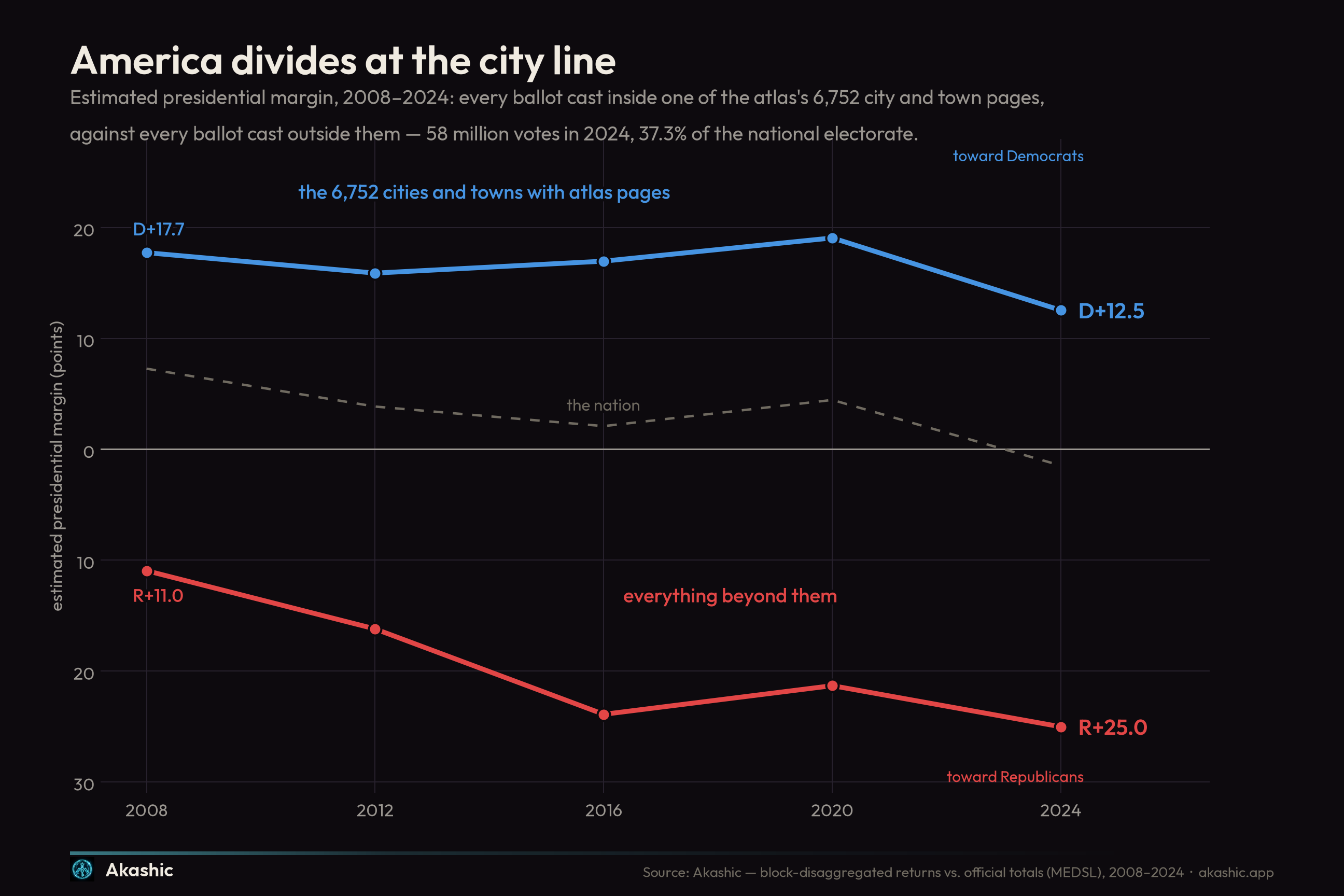
In 2008, the America beyond the current city-page threshold delivered R+11.6 while its cities delivered D+16.4 — a 28.0-point gap. Sixteen years later the same residual delivered R+25.8 against the cities' D+10.7 — a 36.6-point gap. The 2020 election moved the residual 2.6 points toward the Democrats from its 2016 mark; 2024 took that back and more. Across five cycles, the residual moved 14.2 points toward the Republicans while the nation as a whole moved 8.7.
| Cycle | The 10,192 atlas places | Beyond the city line | The nation | Beyond, share of vote |
|---|---|---|---|---|
| 2008 | D+16.4 | R+11.6 | D+7.3 | 32.5% |
| 2012 | D+14.1 | R+17.5 | D+3.9 | 32.4% |
| 2016 | D+15.0 | R+24.7 | D+2.1 | 32.6% |
| 2020 | D+17.2 | R+22.1 | D+4.5 | 32.4% |
| 2024 | D+10.7 | R+25.8 | R+1.5 | 33.4% |
One structural fact in that table deserves attention: the share. The electorate beyond the current city-page threshold supplied between 32.4% and 33.4% of the national vote across these five elections. Its size has been unusually stable. The margins are doing most of the moving.
Three rings, not two
"Rural America" is usually spoken of as one thing. The census-place geography used here produces three rings. Inside the current city line sit the 10,192 places large enough for an atlas page. Outside it sit two distinct Americas: about 14.4 million people in census places under 2,500, and 82.5 million people in no census place at all.
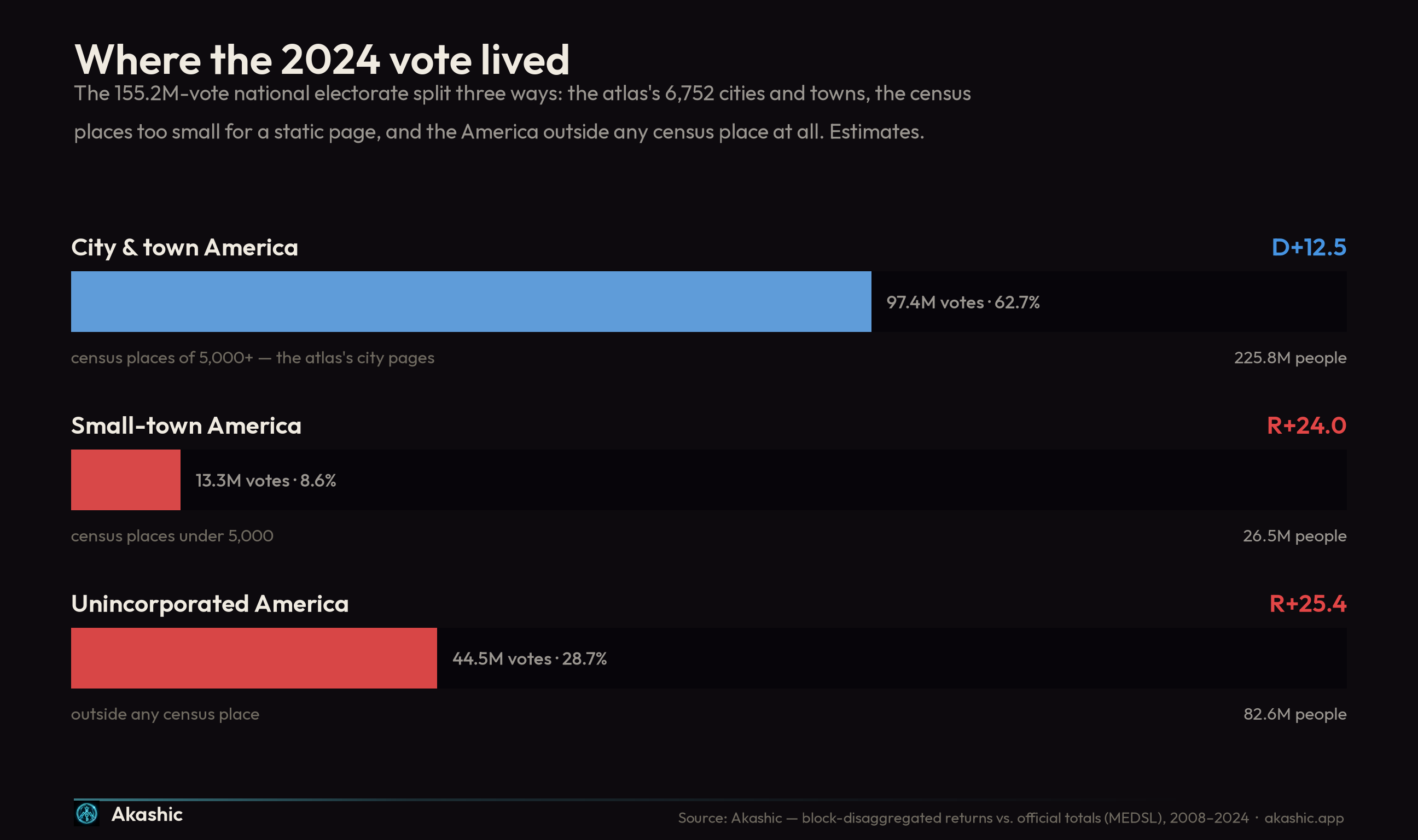
| People | Votes, 2024 | Share of the vote | Margin, 2024 | Margin, 2008 | |
|---|---|---|---|---|---|
| City & town America — census places of 2,500 or more | 238.0M | 103,387,193 | 66.6% | D+10.7 | D+16.4 |
| Small-town America — census places under 2,500 | 14.4M | 7,356,452 | 4.7% | R+28.7 | R+7.7 |
| Unincorporated America — outside any census place | 82.5M | 44,497,197 | 28.7% | R+25.4 | R+12.4 |
The two outer rings now vote similarly, but not identically: R+28.7 in the smallest named places and R+25.4 outside any census place, a 3.4-point gap. They began farther apart in 2008, at R+7.7 and R+12.4. Since then the under-2,500 ring moved 21.0 points toward the Republicans; the unincorporated ring moved 13.0. The largest discontinuity is still at the atlas threshold: in 2024 the margin changes by about 36.6 points between the combined residual and the places inside the line.
The states outside their cities
Run the same subtraction inside each state — the statewide return minus the state's current atlas places — and another map emerges: the fifty states as their small-town and unincorporated remainders.
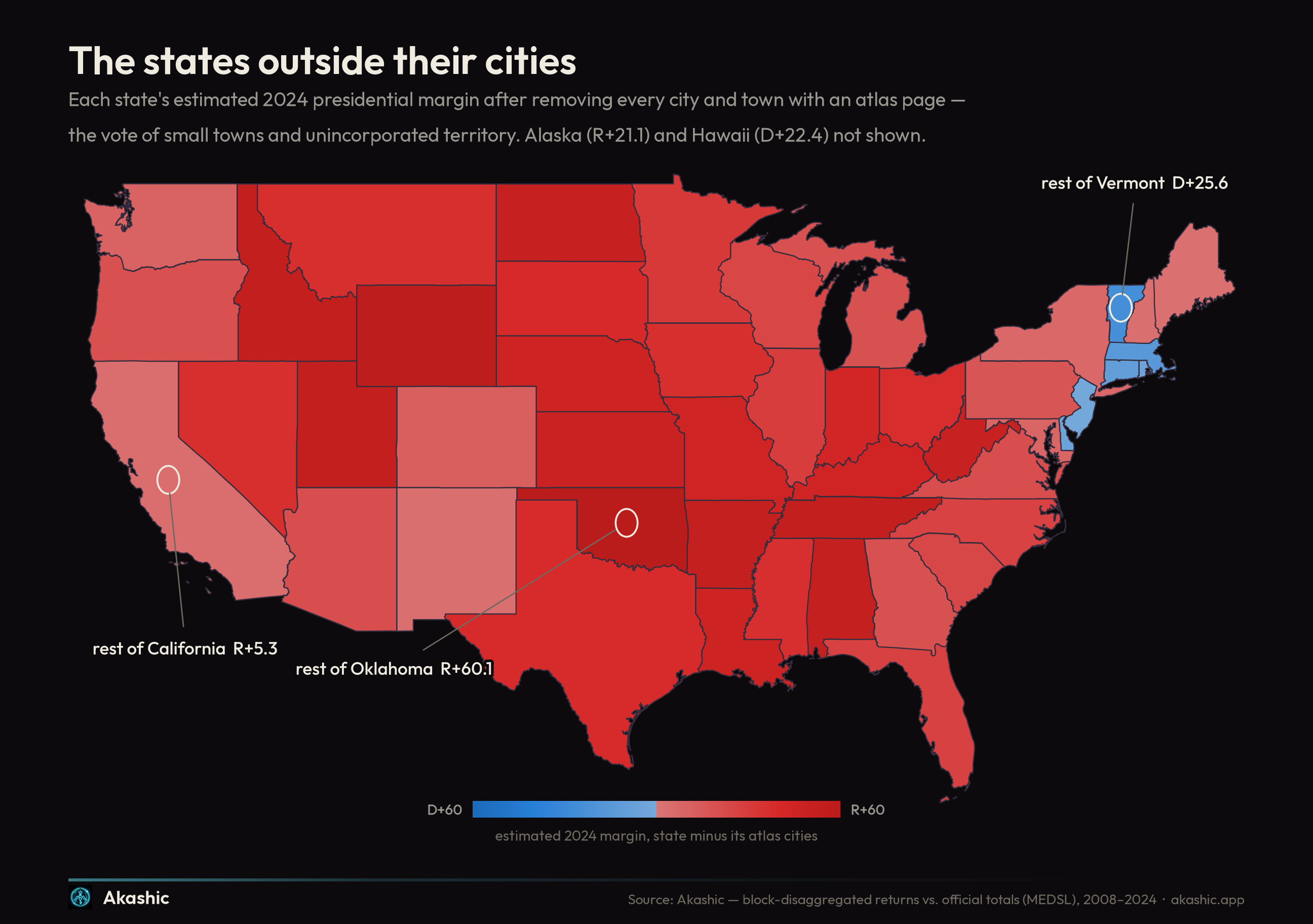
Seven of these remainders voted Democratic in 2024. Six are in the Northeast: Vermont at D+25.3, Massachusetts at D+15.8, Connecticut at D+9.9, Delaware at D+6.1, Rhode Island at D+4.6, and New Jersey at D+1.3. Hawaii, at D+26.3, is the exception outside the region.
Elsewhere the remainders range from competitive to overwhelming. Rest-of-California moved from D+6.8 in 2008 to R+7.8 in 2024. Rest-of-New York moved from essentially even to R+9.1. Old rural components of the Democratic coalition inverted more sharply: rest-of-Iowa moved from R+3.1 to R+39.5, rest-of-Illinois from R+4.8 to R+31.4, and rest-of-West Virginia from R+17.3 to R+51.9. At the far end sits rest-of-Oklahoma, the most Republican remainder in the current calculation at R+61.4.
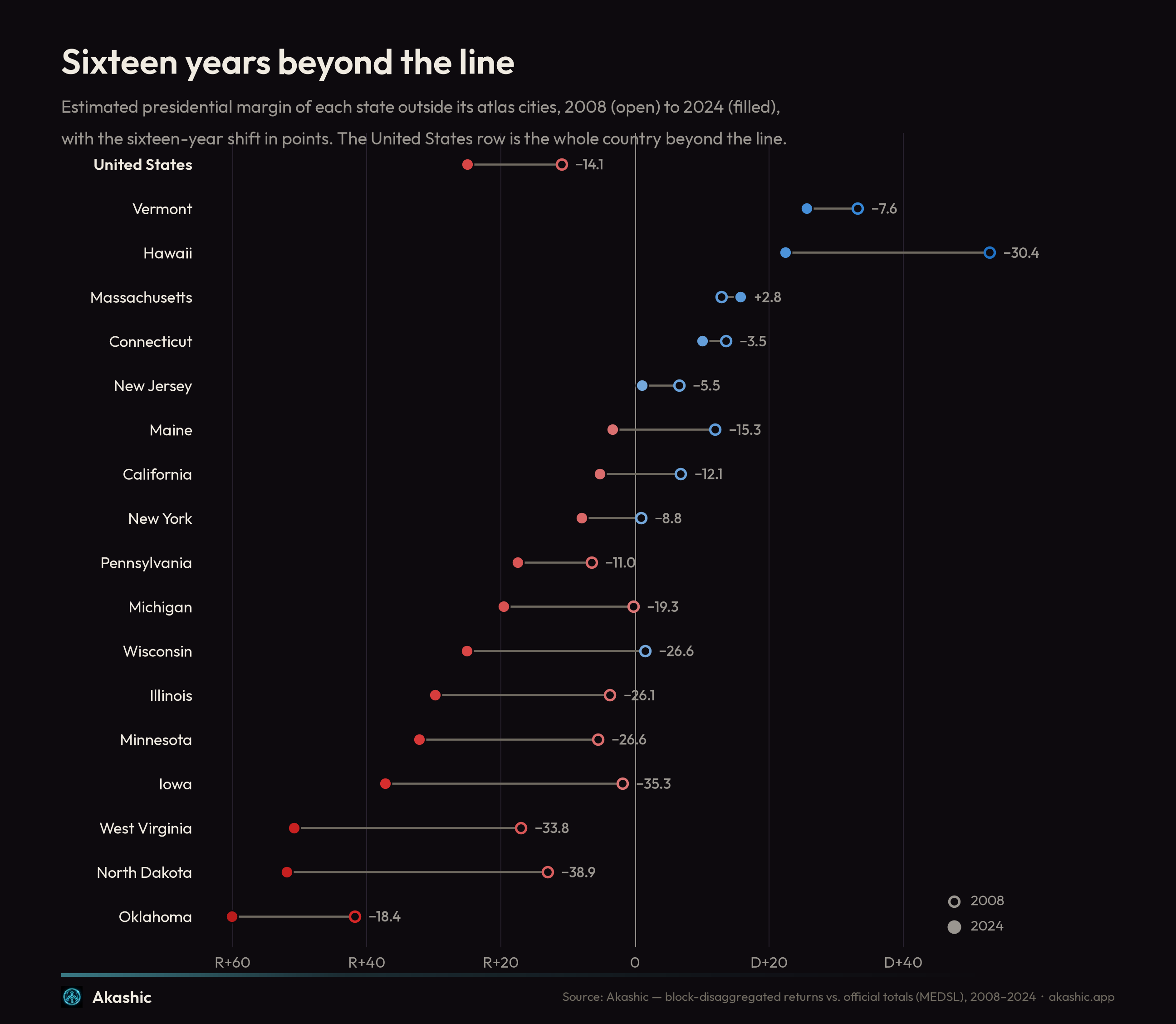
Only four remainders moved toward the Democrats over the full sixteen years: Georgia by 3.8 points, Massachusetts by 3.0, Alaska by 2.0, and Maryland by 0.4. The other 46 moved right.
The battleground arithmetic is visible in raw scale as well as margin. In 2024, the remainder accounted for about 4.0 million votes in Pennsylvania at R+18.8, 3.0 million in Michigan at R+20.1, and 1.2 million in Wisconsin at R+26.1. Those are not forecasts or certified municipal returns; they are estimated residuals. But they show the load a Democratic margin inside the city line must carry.
The complete ledger
The full accounting, ordered from the most Democratic to the most Republican 2024 remainder. The shift column is the sixteen-year change in points; a negative number is movement toward the Republicans. The District of Columbia is omitted because its one atlas place spans the district.
| State | 2008 | 2024 | Shift | Votes beyond the line, 2024 |
|---|---|---|---|---|
| Hawaii | D+53.4 | D+26.3 | −27.1 | 41,360 |
| Vermont | D+33.1 | D+25.3 | −7.8 | 277,856 |
| Massachusetts | D+12.8 | D+15.8 | +3.0 | 1,312,542 |
| Connecticut | D+13.7 | D+9.9 | −3.8 | 856,276 |
| Delaware | D+17.7 | D+6.1 | −11.7 | 337,509 |
| Rhode Island | D+16.1 | D+4.6 | −11.5 | 245,999 |
| New Jersey | D+7.1 | D+1.3 | −5.8 | 1,866,465 |
| Maine | D+11.9 | R+3.9 | −15.8 | 518,629 |
| New Hampshire | D+3.5 | R+3.9 | −7.5 | 498,073 |
| New Mexico | D+18.1 | R+4.0 | −22.2 | 247,541 |
| California | D+6.8 | R+7.8 | −14.6 | 1,117,320 |
| New York | R+0.0 | R+9.1 | −9.1 | 2,270,714 |
| Washington | R+4.1 | R+11.6 | −7.5 | 933,995 |
| Maryland | R+12.9 | R+12.5 | +0.4 | 682,071 |
| Colorado | R+10.3 | R+14.4 | −4.1 | 598,906 |
| Pennsylvania | R+8.1 | R+18.8 | −10.6 | 4,025,591 |
| Georgia | R+23.0 | R+19.2 | +3.8 | 2,951,484 |
| Alaska | R+21.9 | R+19.9 | +2.0 | 63,890 |
| Michigan | R+0.8 | R+20.1 | −19.3 | 3,015,406 |
| Oregon | R+7.6 | R+20.4 | −12.8 | 596,193 |
| Arizona | R+11.0 | R+20.5 | −9.4 | 338,330 |
| Virginia | R+13.4 | R+21.5 | −8.0 | 1,720,976 |
| South Carolina | R+13.6 | R+25.2 | −11.6 | 1,478,425 |
| Wisconsin | D+1.1 | R+26.1 | −27.1 | 1,217,619 |
| Florida | R+10.6 | R+27.3 | −16.7 | 2,916,736 |
| North Carolina | R+17.2 | R+27.7 | −10.4 | 2,508,196 |
| Illinois | R+4.8 | R+31.4 | −26.6 | 1,138,185 |
| Minnesota | R+6.5 | R+34.8 | −28.3 | 820,224 |
| Nevada | R+23.7 | R+37.3 | −13.6 | 110,872 |
| Mississippi | R+22.5 | R+37.6 | −15.1 | 711,210 |
| Montana | R+16.7 | R+38.0 | −21.3 | 294,680 |
| Texas | R+34.2 | R+38.5 | −4.3 | 3,409,799 |
| Ohio | R+16.9 | R+39.3 | −22.4 | 2,201,364 |
| Iowa | R+3.1 | R+39.5 | −36.4 | 608,638 |
| South Dakota | R+12.5 | R+41.7 | −29.2 | 177,115 |
| Indiana | R+16.5 | R+44.0 | −27.5 | 1,203,293 |
| Kentucky | R+22.2 | R+45.9 | −23.7 | 1,128,665 |
| Nebraska | R+35.1 | R+46.8 | −11.8 | 358,777 |
| Missouri | R+18.9 | R+47.8 | −28.9 | 1,179,546 |
| Louisiana | R+40.6 | R+51.2 | −10.7 | 852,887 |
| Kansas | R+38.4 | R+51.8 | −13.4 | 384,527 |
| West Virginia | R+17.3 | R+51.9 | −34.6 | 538,244 |
| North Dakota | R+13.2 | R+52.7 | −39.5 | 144,288 |
| Utah | R+45.6 | R+53.3 | −7.7 | 151,444 |
| Alabama | R+38.7 | R+53.6 | −14.9 | 964,654 |
| Tennessee | R+34.1 | R+54.4 | −20.3 | 1,360,943 |
| Arkansas | R+31.4 | R+54.8 | −23.4 | 515,812 |
| Idaho | R+40.3 | R+55.8 | −15.4 | 331,255 |
| Wyoming | R+45.0 | R+58.6 | −13.7 | 110,138 |
| Oklahoma | R+42.8 | R+61.4 | −18.6 | 518,997 |
What the ledger says
For Democrats, the current residual has moved sharply away from the party: R+11.6 in 2008 to R+25.8 in 2024. The seven Democratic remainders are genuine exceptions, not evidence that the national pattern has reversed.
For Republicans, about one-third of the national vote now delivers a 25.8-point margin. That is a major component of the party's electoral floor, but not an endlessly expanding pool: the residual's national vote share has remained close to one-third in every cycle shown. Close states still turn on how margins inside and outside the line balance each other.
The atlas carries this electorate as a standing figure on the United States page and in the side panel of the national map, updated with each data pass.