
The editorial record of Akashic

The Akashic Record
Premium, sourced essays on the machinery, forecasts, and precedents beneath American elections — cartography, coalition analysis, and the long presidential record, read from the atlas.
- Pieces
- 14
- Record
- 1892–2026
- Updated
- Aug 2026
- Syndication
- RSS feed
Dwayne the Swamp
Donald Trump built a coalition of incompatible estrangements. Could The Rock represent its opposite—a solar coalition held together not by shared grievance, but by shared recognition?
Read the essay →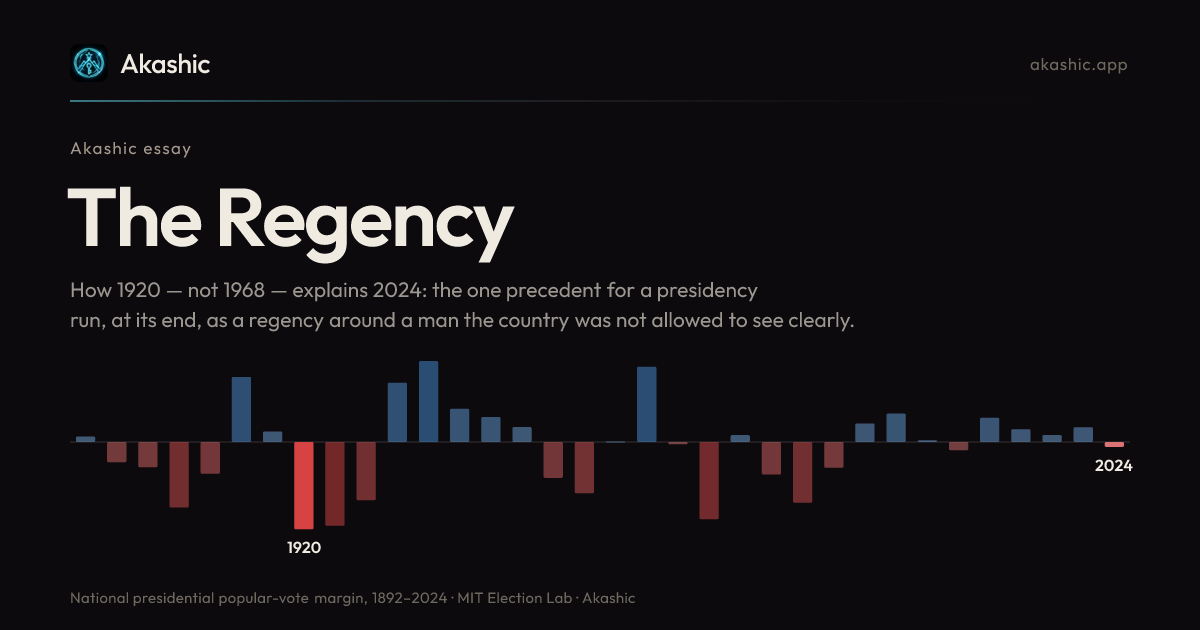
The Regency
How 1920 — not 1968 — explains 2024: the one precedent for a presidency run, at its end, as a regency around a man the country was not allowed to see clearly.
The Inheritance
The 2028 Republican primary will not be a contest to replace Donald Trump. It will be a contest to inherit the political center he created—and to survive the men who police its borders.
A Two-Name Theory of the 2028 Democratic Primary
My first locked nomination book gives Alexandria Ocasio-Cortez and Gavin Newsom 30 percent each—and treats the rest of Polymarket’s sprawling field as a search for a vessel.
The Ninety-One
The 91 Census places with at least 250,000 residents cast more presidential votes in 2024 than any state. Across six elections — added, never averaged — the Democratic map inside them expanded by 18 cities while the combined margin moved 5.5 points.
The electorates that showed up on August 4
Missouri’s new congressional map produced one near-tie hidden inside a red state, while Michigan’s Democratic primary electorate arrived in statewide force.
The Trickster’s Republic
There are 55 American counties where most residents speak a language other than English at home. Together they swung 15.2 points toward Donald Trump in 2024. They do not speak the same language—and they did not move for the same reason.
The Migration Map Behind the Vote
Every year, millions of Americans move from one county to another. The tax man counts them, the Census counts them, and — read against the political map — their movement tells a story the election returns alone cannot.
The Map of Veto Power
Fifty governorships do not form a chamber, but together they describe where executive power can stop a bill, appoint a judge, administer an election, and redraw the practical boundaries of public life.
The Long Road to 218
A House majority is assembled across 435 districts, but it is judged at one threshold: 218. The map can look broad while the route through its center remains narrow.
Fifty Is Not Enough
The Senate’s decisive number in 2026 is 51. A 50–50 chamber would be organized by Republicans because the Republican vice president holds the tiebreak.
Beyond the City Line
Nearly 52 million 2024 votes were cast outside the 10,192 city and town pages in the current American atlas. Combined, they form an electorate larger than any state — and one the usual election-night maps never show as a whole.
The Ballot They Asked For
Across Colorado's eight congressional districts, Democratic House-primary votes made up a larger share of two-party House-primary participation in 2026 than in 2022 or 2024. The shift is broad, but the totals do not identify how unaffiliated voters divided or separate voter preference from contestedness.
The Machine Vote
What community-level models reveal about the 2024 shift—and why multilingual places moved farther right.
Alongside the essays, Akashic publishes reproducible research. Coalition cycles: distinguishing persuasion, mobilization, and withdrawal →
Figures throughout draw on Akashic’s presidential series (1892–2024), the U.S. Census ACS, MEDSL county returns, and VEST precinct geometry. Every piece names its sources.