
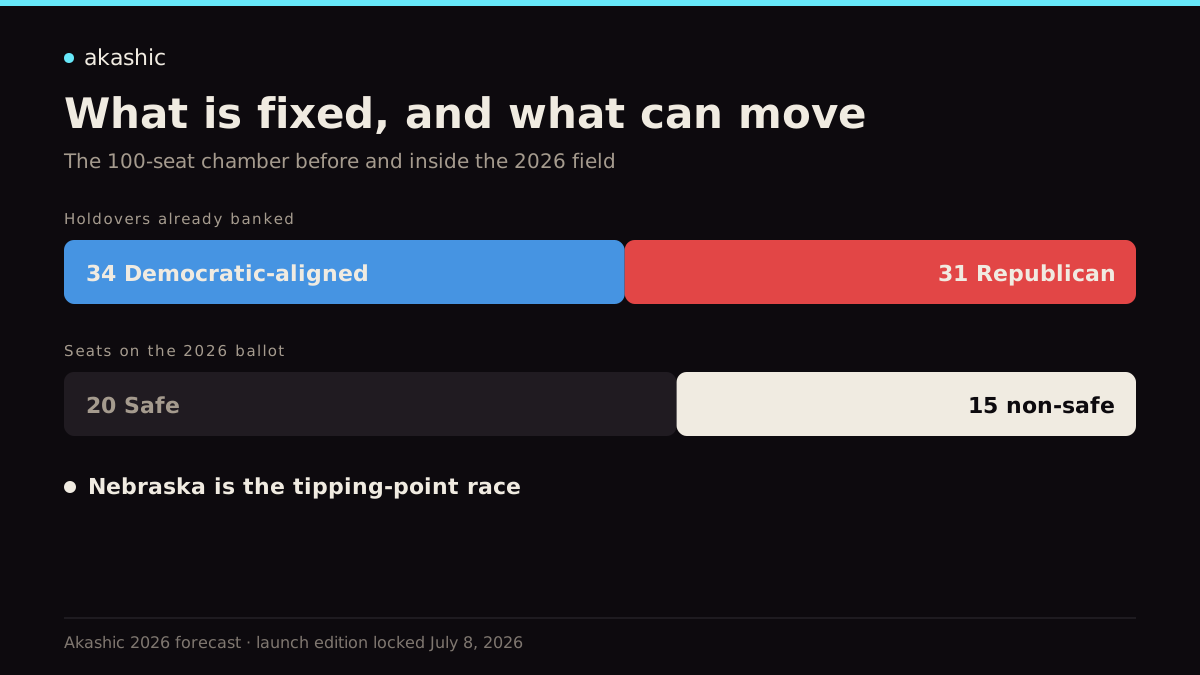
The arithmetic of Senate control begins before the 2026 ballots are counted. Sixty-five seats are holdovers from earlier elections: 34 Democratic-aligned and 31 Republican. The other 35 seats—the regular Class 2 contests plus special elections in Florida and Ohio—make up the field that can move.
That starting position gives Democrats an advantage, but not the same advantage a 34–31 score would imply in an ordinary chamber. Fifty Democratic seats do not produce Democratic control. The party must reach 51, and the launch edition’s median lands exactly there.
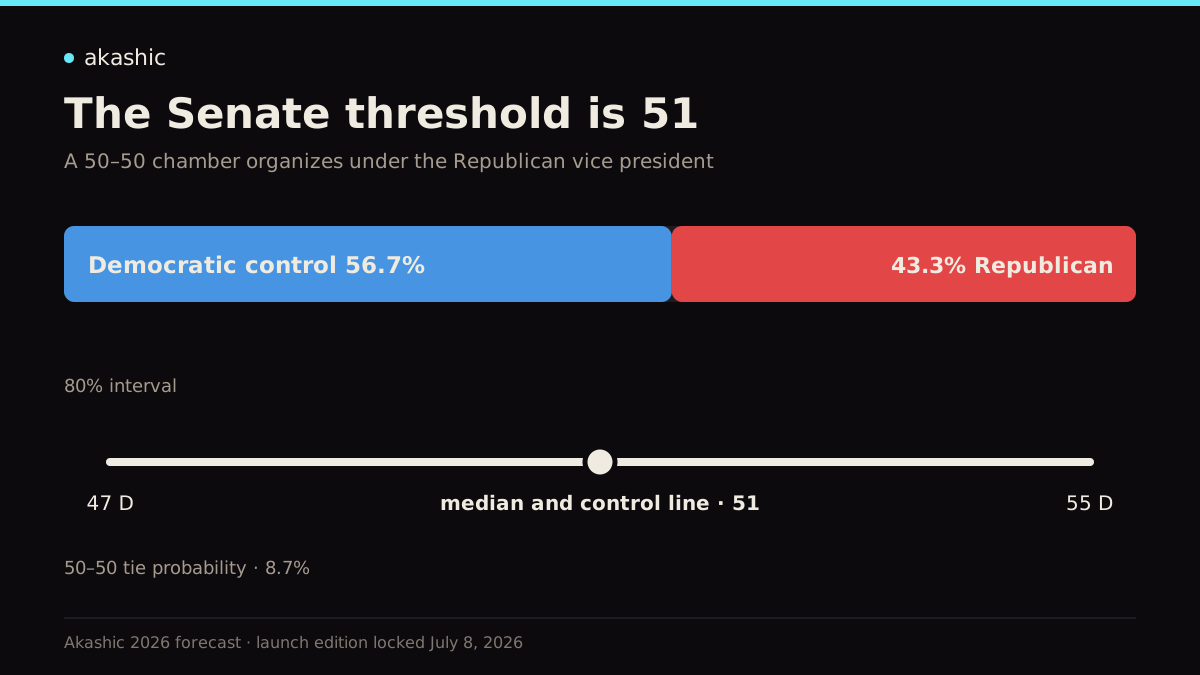
| Measure | Launch edition, locked July 8 |
|---|---|
| Seats up in 2026 | 35 |
| Democratic-aligned holdovers | 34 |
| Republican holdovers | 31 |
| Democratic control line | 51 |
| Democratic control probability | 56.7% |
| Republican control probability | 43.3% |
| 50–50 probability | 8.7% |
| Median Democratic seats | 51 |
| 80% interval | 47–55 Democratic seats |
| Non-safe races | 15 |
| Tipping-point race | Nebraska |
A 56.7% probability is an edge, not a cushion. The 80% interval runs from 47 Democratic seats to 55, crossing the control line and leaving meaningful room on both sides. The 8.7% tie probability deserves special attention because it is not neutral: in the institutional rules governing this election, a tie belongs in the Republican-control column.
The chamber before the campaign
The holdovers explain why Democrats can begin with a narrow advantage even while facing a difficult set of individual races. They also explain why the Senate cannot be read as 35 isolated contests. Each rated race adds to a structure that is already mostly fixed.
Of the 35 seats on the ballot, 20 are Safe—ten for each party. The remaining 15 form the working map: six Tilt, three Lean, and six Likely. That is small enough to inspect race by race, but large enough that no single national narrative accounts for all of it.
The Democratic offensive map in the launch edition includes projected flips in North Carolina, Alaska, Iowa, Texas, and the Ohio special election. The ratings are not interchangeable. North Carolina is the firmer call. Alaska, Iowa, Texas, and Ohio are Tilt Democratic—the first opportunities likely to disappear if the environment moves right or the local case weakens.
Republicans do not need to erase every Democratic opportunity. They need to keep enough of those opportunities from becoming seats, while taking advantage of any Democratic defense that loosens. A party can win the more memorable contests and still fail to organize the chamber. The control line is an accumulation, not a highlight reel.
Nebraska, at the threshold
Nebraska is the launch edition’s tipping-point race. Its independent candidacy makes the label especially instructive. The relevant question is not only which candidate wins, but how the winner would organize the chamber. A two-party color alone cannot answer that.
As with every tipping point, Nebraska’s position is conditional. It is the contest nearest the 51-seat threshold in the forecast’s ordering, not a claim that every route to control passes through the same state. Its value is explanatory: it shows how a close chamber can turn on a race whose alignment cannot be inferred safely from a familiar party label.
The surrounding contests illustrate other kinds of risk. Michigan is a Democratic open-seat defense that needs to remain uneventful for the offensive map to matter. Maine is a Republican-leaning contest near enough to the center to affect the chamber without being a pure toss-up. Texas is an opportunity because it is difficult, not despite being difficult; a forecast that places it on the Democratic side is making a visible, testable judgment.
How to read this map
Begin with the rule: Democrats require 51. Then separate the holdovers from the seats on the ballot. Within the ballot field, treat Safe seats as the floor, Lean and Likely seats as the guardrails, and Tilt seats as the part of the distribution most likely to reorder.
The launch edition gives Democrats the better path, but only narrowly. Its central outcome is the minimum seat count that produces Democratic control, and its interval extends four seats to either side of that line. The most faithful summary is therefore not that the Senate leans safely toward one party. It is that Democrats have more routes to 51, while Republicans retain a large set of outcomes in which the chamber stops at 50 or turns before it gets there.