
Polymarket offers an enormous 2028 Democratic field. My book begins by removing most of it.
I have Alexandria Ocasio-Cortez at 30 percent and Gavin Newsom at 30 percent. That is 60 percent on two people before reaching a governor from Illinois or Maryland, a former mayor, an actor, a former president, a basketball player, or anyone the market has not named yet.
This is not a model. It is not a poll average with a probability curve draped over it. It is my first dated attempt to put exact numbers behind an argument: the Democratic nomination is much more likely to go to one of two candidates than the market believes, and the remaining paths are divided between governors with real electoral records and figures who could enter politics carrying a national relationship already built somewhere else.
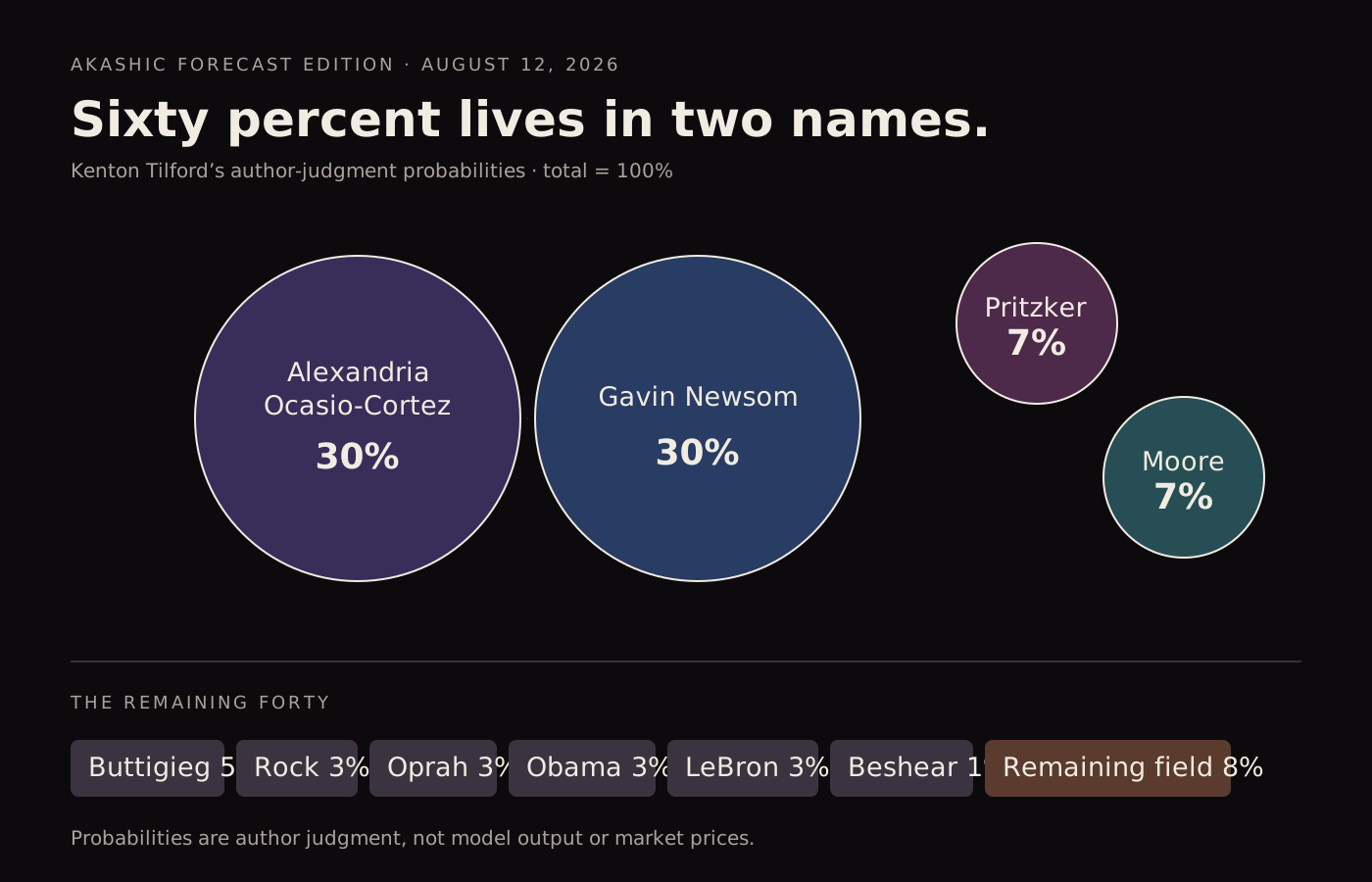
| Candidate or bucket | My probability | Tier |
|---|---|---|
| Alexandria Ocasio-Cortez | 30% | The two-name field |
| Gavin Newsom | 30% | The two-name field |
| J.B. Pritzker | 7% | Executive alternative |
| Wes Moore | 7% | Executive alternative |
| Pete Buttigieg | 5% | Narrow path |
| Dwayne “The Rock” Johnson | 3% | Celebrity option |
| Oprah Winfrey | 3% | Celebrity option |
| Barack Obama | 3% | Constitutional-crisis tail |
| LeBron James | 3% | Celebrity option |
| Andy Beshear | 1% | Narrow path |
| Remaining field | 8% | Everyone else combined |
| Total | 100% |
The 8 percent field is an accounting bucket, not Polymarket’s literal “Other” contract. Polymarket runs this event as an augmented negative-risk market: unnamed placeholders can become named people, while the terminal meaning of “Other” changes as the market expands. I would not treat that instrument as a stable proxy for “everyone outside my ten named outcomes.”
The board is not the book
At the lock, Polymarket asked 18.3 cents for AOC and 17.5 for Newsom. My 30 percent estimates create the two largest liquid disagreements near the top of the market.
The deeper gaps are lower down. Pritzker was offered at 1.2 cents and Moore at 1.5. Oprah, Barack Obama, and LeBron James were each three-tenths of a cent or less. Those are not predictions that any of them is likely to win. They are claims that the market price is far too close to zero for a political future with more than two years left to mutate.
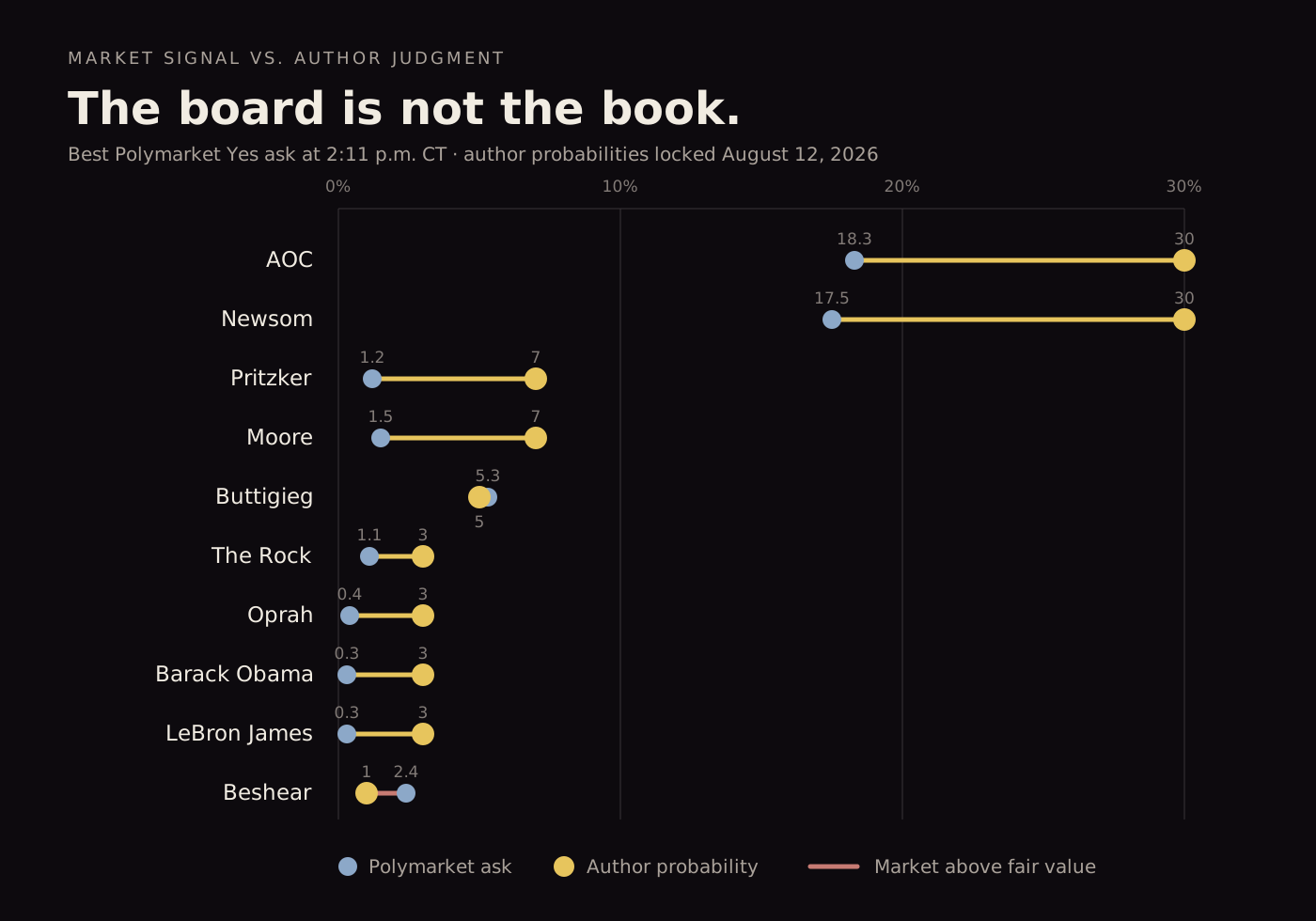
| Candidate | Polymarket ask | My probability | Edge vs. ask | Call at ask |
|---|---|---|---|---|
| Alexandria Ocasio-Cortez | 18.3¢ | 30% | +11.7 pts | Buy |
| Gavin Newsom | 17.5¢ | 30% | +12.5 pts | Buy |
| J.B. Pritzker | 1.2¢ | 7% | +5.8 pts | Buy |
| Wes Moore | 1.5¢ | 7% | +5.5 pts | Buy |
| Pete Buttigieg | 5.3¢ | 5% | −0.3 pts | Sell / avoid |
| Dwayne “The Rock” Johnson | 1.1¢ | 3% | +1.9 pts | Buy |
| Oprah Winfrey | 0.4¢ | 3% | +2.6 pts | Buy |
| Barack Obama | 0.3¢ | 3% | +2.7 pts | Buy |
| LeBron James | 0.3¢ | 3% | +2.7 pts | Buy |
| Andy Beshear | 2.4¢ | 1% | −1.4 pts | Sell |
The arithmetic is mechanical once the probabilities are locked. It also overturns one of my first impressions: Buttigieg looked like a marginal buy around five cents, but a 5 percent fair value against a 5.3-cent ask is no longer a buy. Beshear at 1 percent is a clearer sell at 2.4.
The other named sells are Jon Ossoff at 15.8 cents, Kamala Harris at 7.6, Josh Shapiro at 5.0, Mark Kelly at 3.3, Rahm Emanuel at 2.5, Ro Khanna at 2.3, and James Talarico at 2.0. I have not pretended to assign each one a precise tenth-of-a-point probability inside the 8 percent field. The claim is narrower: each individual contract costs too much relative to the path I can see.
An early primary poll is measuring something different. Emerson’s July 2026 national survey put Buttigieg at 19 percent, Newsom at 17, Ossoff and AOC at 13, Harris at 8, and Beshear at 7. Those are stated preferences in a hypothetical ballot test. A nomination probability also has to price entry decisions, coalition movement, fundraising, delegate rules, scandals, consolidation, and the chance that the entire field changes shape. Poll share and event probability should not be read as interchangeable units.
AOC, and the district that moved farthest toward Trump
My AOC case is not that New York’s 14th District remained frozen in progressive amber. It did the opposite.
On the congressional boundaries used in 2024, Joe Biden carried NY-14 by 55.2 points in 2020. Kamala Harris carried the same territory by 31.8 points in 2024. That 23.4-point movement toward the Republican ticket was the largest of all 435 congressional districts in calculations published by The Downballot.
AOC did better than Harris in the district. She defeated Tina Forte by about 38.4 points. But Kirsten Gillibrand ran very slightly ahead of her there, winning the Senate vote by about 39 points. And AOC remained far below Biden’s reconstructed 2020 presidential margin.
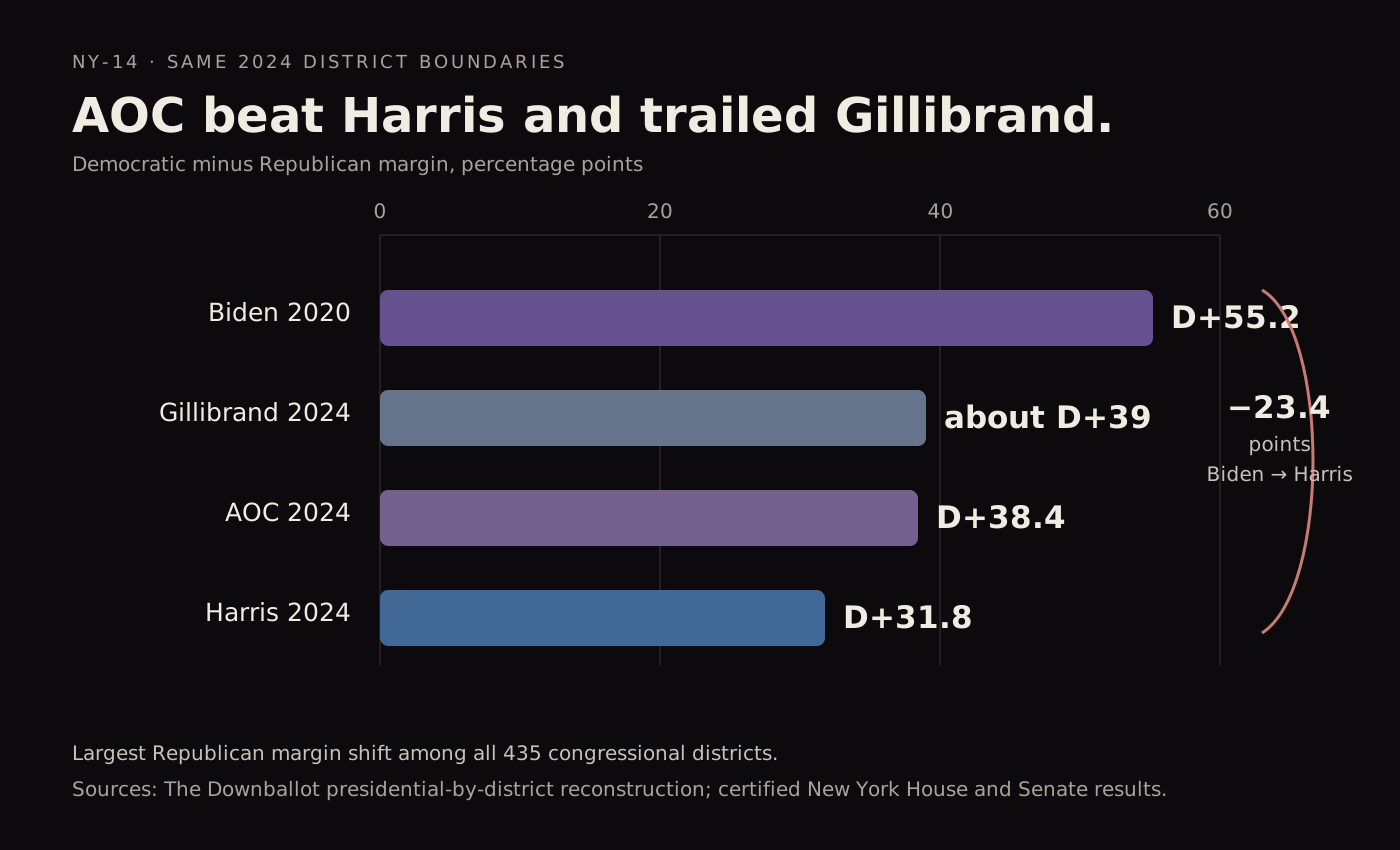
That is the correct ordering. AOC showed personal strength without escaping the district’s larger movement. She was not the only Democrat capable of outrunning Harris, and the size of her victory should not be confused with the much larger Democratic advantage Biden had held four years earlier.
Her own House sequence still matters. She won 78.1 percent in 2018, 71.6 in 2020, 70.6 in 2022, and 69.2 in 2024. New York fusion lines and a district-boundary change complicate a straight trend, but the basic record is four decisive general-election victories and a declining share as the surrounding presidential electorate became more Republican.
| AOC general election | Votes | Vote share | Margin over top opponent |
|---|---|---|---|
| 2018 | 110,318 | 78.1% | D+64.5 |
| 2020 | 152,661 | 71.6% | D+44.2 |
| 2022 | 82,453 | 70.6% | D+43.3 |
| 2024 | 132,714 | 69.2% | D+38.4 |
I sometimes think of AOC as the Millennial Obama. The comparison is about political presence more than ideology: the ability to make generational succession feel embodied rather than announced, to make a candidacy seem larger than a résumé, and to turn attention into identification.
NY-14 is not evidence that this ability automatically wins back every voter who left the Democratic presidential ticket. It is evidence that the most Obama-esque figure in the Democratic field was able to retain a measurable personal margin inside the district that moved farthest toward Trump. That unresolved gap is part of the reason I want to own 30 percent at 18.3 cents. It contains upside and a warning in the same place.
Newsom, and the ordinary path done at scale
Newsom is the other 30 percent because he does not require the same imaginative leap.
He won the 2018 California governor’s race with 61.9 percent and a 23.9-point all-party margin. He won reelection in 2022 with 59.2 percent and an 18.4-point margin. California is favorable terrain for a Democrat, and a California general-election landslide is not a national primary. But Newsom has twice run and won a state containing almost every constituency a Democratic nominee eventually has to organize.
The ordinary path can be underrated precisely because it is ordinary: govern a giant state, build the donor and media apparatus, confront a Republican president, and enter the primary already legible as a national combatant. At 17.5 cents, the market is charging less than one chance in five for a candidate whose route requires fewer unprecedented events than almost anyone else’s.
AOC and Newsom are not interchangeable. My tie says the paths are comparably likely, not that the candidates possess the same strengths. AOC is the generational candidate. Newsom is the scaled executive and partisan fighter. One asks Democrats to recognize a new era. The other asks them to pick the man already behaving as though the national campaign began.
The governors at seven
Pritzker and Moore are my second tier, both at 7 percent. The market prices—1.2 and 1.5 cents—treat them as marginal names. Their election records make that hard to defend.
| Candidate | Election | Democratic share | All-party margin |
|---|---|---|---|
| Gavin Newsom | California governor, 2018 | 61.9% | D+23.9 |
| Gavin Newsom | California governor, 2022 | 59.2% | D+18.4 |
| J.B. Pritzker | Illinois governor, 2018 | 54.5% | D+15.7 |
| J.B. Pritzker | Illinois governor, 2022 | 54.9% | D+12.5 |
| Wes Moore | Maryland governor, 2022 | 62.0% | D+27.1 |
| Andy Beshear | Kentucky governor, 2019 | 49.1% | D+0.4 |
| Andy Beshear | Kentucky governor, 2023 | 52.5% | D+5.1 |
Pritzker has won Illinois twice, first by 15.7 points and then by 12.5. He has money, an executive record, and the ability to occupy an anti-Trump lane without looking as though he discovered it for the presidential cycle. At 1.2 cents, he is the clearest conventional-politician buy on the board.
Moore’s single statewide race was enormous: 62.0 percent and a 27.1-point margin in Maryland in 2022. Maryland is deeply Democratic, so the result does not prove a national coalition. It proves that his political résumé already contains a clean executive victory with room to build. Seven percent is an option on what happens if Democratic voters meet him at presidential scale and like what they see.
Beshear’s record is almost the mirror image. Winning Kentucky as a Democrat—then expanding from a 0.4-point margin in 2019 to 5.1 in 2023—is more electorally unusual than winning Maryland or Illinois. I can strain to see Democrats embracing him. I still price the nomination at only 1 percent. The cultural fit feels too narrow and the national persona too dorky for the field I expect. A real crossover record can be impressive without making a 2.4-cent nomination contract attractive.
Buttigieg’s five-percent path
Pete Buttigieg has won elections, but the scale contrast is severe.
He won South Bend’s mayoralty with 73.9 percent in 2011 and reelection with 80.4 percent in 2015. Between those municipal landslides and his presidential rise sits his 2010 Indiana state-treasurer race: 37.5 percent and a 24.9-point loss. South Bend was friendly territory with low-turnout municipal elections. Indiana was a hostile statewide test in a Republican wave. Both belong in the record.
His 2020 presidential campaign proved that he could turn a mayoralty into a top-tier national candidacy. It did not prove that he can assemble the modern Democratic primary coalition. My 5 percent mostly lives in a strange scenario: Republicans look overwhelmingly likely to win the general election, Democratic intensity collapses, and a thinner, lower-stakes-feeling primary allows Buttigieg’s existing organization and familiarity to carry farther than they would in a high-urgency succession fight.
That path is real. It is not large. Five percent against a 5.3-cent ask is a pass or a small sell.
The celebrity option is not a joke bucket
The Rock, Oprah, and LeBron have no election returns. That absence is not a missing cell in the model. It is the option.
Conventional politicians enter presidential politics carrying recorded votes, institutional enemies, factional ownership, and years of partisan saturation. A national celebrity can enter with mass familiarity acquired before the electorate sorted the person into every political conflict.
I made the fuller case for Dwayne Johnson in “Dwayne the Swamp”: celebrity can create political capital somewhere else, and a figure with enough symbolic bandwidth can allow different constituencies to maintain different authentic relationships with the same candidate. The Rock is unusually close to the ideal form—wrestling and Disney, Black and Samoan, athlete and actor, working-class entertainment and global fame. At 1.1 cents, I would buy the chance that someone persuades him.
Oprah has a different form of political capital: decades of intimate authority, especially with women, built through television rather than party office. LeBron has spent his entire adult life at the center of sports, business, race, education, and civic argument while retaining an audience vastly larger than that of any governor. I am not claiming either is secretly preparing a campaign. I am claiming that three-tenths of a cent is too dismissive of the possibility that a party confronting an abnormal political era looks outside its normal recruiting class.
The field bucket also contains celebrity tails that are too small to break out individually in this edition, including George Clooney and Terry Crews. Crews playing the president in Idiocracy is not a qualification. It is a reminder that political imagination is partly narrative. Volodymyr Zelenskyy’s path from television president to actual president does not make actors generally likely to win office. It makes “impossible because fictional” a category error.
Barack Obama is a constitutional-crisis contract
The 3 percent on Barack Obama is not a cute loophole theory.
The Twenty-Second Amendment says that no person may be elected president more than twice. Under the constitutional order as it exists, Obama cannot simply run for and win a third elected term.
I am pricing the chance that the constitutional order itself becomes the issue: Trump attempts to pursue a third term, the Supreme Court or another institution enables an evasion or rupture, or the amendment is somehow changed or rendered inoperative in practice. In that world, Democrats would have an obvious escalation available to them. Obama would not merely be a former president with residual popularity. He would be the symmetrical answer.
Most futures do not reach that branch. Three percent says that more than one in a hundred might. The Polymarket ask was 0.3 cents.
That is a ten-to-one disagreement about the probability of the scenario, not an argument that ordinary constitutional law currently permits it.
The sells are theories, too
A sell is not a personality review. It is a claim that the contract costs more than the path is worth.
Ossoff at 15.8 cents is the largest conventional sell. A young senator with a plausible biography has become the market’s third giant. I do not see the political presence necessary to justify a probability almost equal to AOC or Newsom.
Harris at 7.6 asks Democrats to return to a nominee who lost in 2024. Kelly at 3.3 is a résumé without a theory of the electorate. Emanuel at 2.5 is profoundly out of step with the current Democratic primary electorate. Talarico at 2.0 combines liberal positioning with a presentation I expect to read as too dorky at presidential scale.
Khanna at 2.3 comes with a local warning. In CA-17, Harris ran about 66.7–28.8 in 2024, a 37.9-point margin. Khanna won his House race about 62.9–37.1, roughly 12 points narrower. Cross-race comparisons are not pure measures of candidate appeal—different opponents, ballot structures, and turnout behavior matter—but “did worse than Harris in his own district” is not the launchpad I want to buy at two cents.
Shapiro at 5.0 has a strong statewide résumé that my book still prices below the market. His Israel positioning is disqualifying in the Democratic primary electorate I expect. That is an editorial judgment, not a result produced by Pennsylvania election returns.
What the election record can—and cannot—tell us
The historical scoreboard puts every conventional contender in the friendliest possible light: it shows that Newsom, Pritzker, Moore, Beshear, Buttigieg, AOC, and Obama have all won real elections. It does not make the offices commensurable.
Obama is the only person in the book who has won the national popular vote: 52.9 percent and D+7.3 in 2008, then 51.0 percent and D+3.9 in 2012. Newsom has won the largest electorate below the presidency. Pritzker and Moore have won blue-state governorships. Beshear has won in a Republican state. Buttigieg has won a city and lost a state. AOC has won a deeply Democratic district while running ahead of the 2024 presidential ticket and slightly behind the Senate ticket.
Each record answers a different question. None answers the nomination by itself.
That is why my probability book does not rank candidates by their most flattering margin. The nomination is a test of whether a candidate can become the common object of a coalition before someone else does. Election results tell us who has already carried which Places. The forecast asks what kind of relationship those victories can become.
What would change this book
| Signal | What I would watch | Likely effect |
|---|---|---|
| AOC coalition test | Endorsements, donor breadth, and polling gains beyond young progressives; evidence from Latino and working-class voters in and beyond NY-14 | Determines whether 30% grows or contracts |
| Newsom conversion | Whether national combativeness converts into primary support outside California | Separates frontrunner strength from media ubiquity |
| Pritzker / Moore exposure | Name recognition followed by vote choice, not name recognition alone | Tests the two 7% executive options |
| Celebrity entry behavior | Staff recruitment, donor calls, early-state travel, or explicit openness | Converts cheap option value into a campaign path |
| Republican third-term escalation | Concrete legal, party, judicial, or constitutional steps rather than rhetoric | Controls the Obama tail |
| Democratic defeatism | Evidence that voters expect a GOP win and disengage from the primary | Expands the Buttigieg path |
| New entrant | A candidate not itemized here builds a real coalition | Comes first from the 8% field bucket |
The next edition should not move because a cable-news day felt important. It should move when one of these paths becomes more or less available.
For now, the book remains stark. AOC and Newsom together are 60 percent. Pritzker and Moore are the serious executive alternatives. Buttigieg and Beshear occupy narrow conventional paths. The celebrity contracts are radically underpriced because the market is treating political experience as the only form of political capital. Obama is a bet on constitutional rupture, not ordinary succession.
The market sees a field.
I see two leading vessels—and a series of increasingly strange ways the party might decide neither one is enough.