
The conventional way to imagine a presidential primary is as an empty stage. Candidates enter. Factions choose. Money and momentum accumulate. One person takes the nomination.
The 2028 Republican stage is not empty.
Donald Trump is still standing in its center. The two likeliest nominees serve in his administration. His eldest son is on the board. His former strategist is trying to make a third term thinkable. The most plausible insurgent is a broadcaster arguing that Trump betrayed Trumpism. Even the candidates imported from the Democratic Party became nationally meaningful through Trump.
That is why my book starts with J.D. Vance at 40 percent and Marco Rubio at 25 percent, then places Donald Trump himself at 10 percent. The remaining 25 percent is divided among Tucker Carlson, Greg Abbott, Donald Trump Jr., Tulsi Gabbard, Robert F. Kennedy Jr., Ron DeSantis, and a ten-percent field.
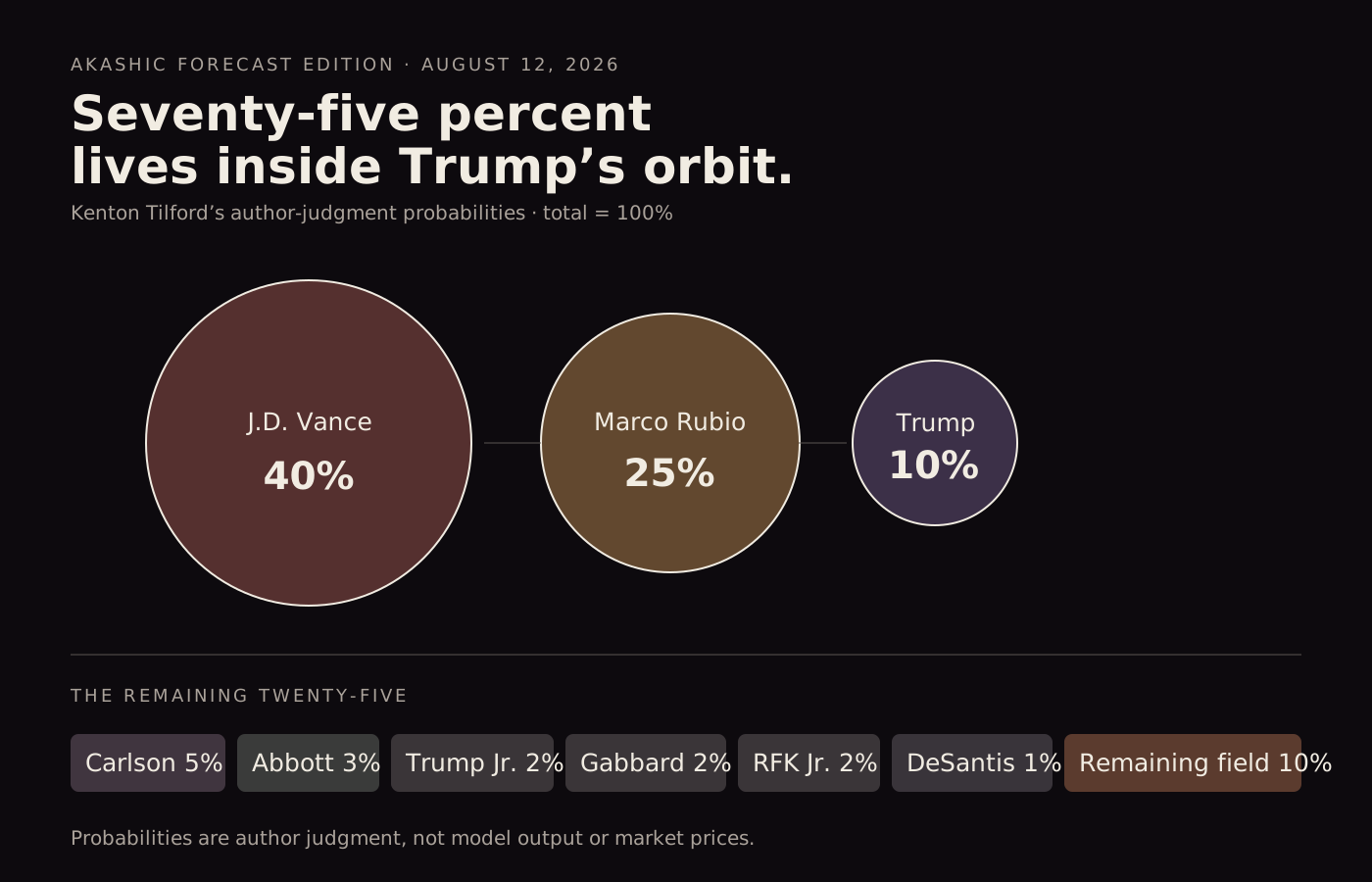
| Candidate or bucket | My probability | Role in the succession |
|---|---|---|
| J.D. Vance | 40% | Presumptive heir |
| Marco Rubio | 25% | Alternative heir |
| Donald Trump | 10% | Constitutional-crisis tail |
| Tucker Carlson | 5% | Doctrinal insurgent |
| Greg Abbott | 3% | Governor fallback |
| Donald Trump Jr. | 2% | Dynastic continuity |
| Tulsi Gabbard | 2% | Convert candidate |
| Robert F. Kennedy Jr. | 2% | Convert candidate |
| Ron DeSantis | 1% | Failed first attempt |
| Remaining field | 10% | Everyone else combined |
| Total | 100% |
The ten-percent field is an accounting bucket, not Polymarket’s literal “Other” contract. The market can add names and reassign its terminal residual. My field means everyone outside the nine people I have itemized. Ron DeSantis is not part of it: he has his own one-percent line and, at a three-cent ask, is a sell.
The board and the book
Polymarket’s 2028 Republican market locates the same two-man succession at the top. Its best Yes asks were 44.2 cents for Vance and 23.2 for Rubio. My revised book is slightly less confident in Vance and slightly more confident in Rubio.
The move from Vance 44 / Rubio 23 to Vance 40 / Rubio 25 reflects Trump’s penchant for pitting prospective heirs against each other. He can strengthen Vance without closing the door on Rubio, then strengthen Rubio without formally withdrawing anything from Vance. Each man remains dependent on Trump’s next signal, and Trump remains the final judge of a contest he has declined to settle.
That is already the shape of his succession politics. Trump has privately told donors to support Vance while publicly withholding an endorsement and continuing to ask advisers about both men, according to The Washington Post. The adjustment prices that managed rivalry: Vance remains the clear favorite, but Rubio gains probability every time Trump preserves him as a live alternative.
The disagreement begins immediately afterward.
The market asked 2.1 cents for Trump; I have him at 10 percent. It asked 2.5 for Carlson; I have him at five. Abbott was eight-tenths of a cent against my three percent. Gabbard and Kennedy were each offered at half a cent against my two.
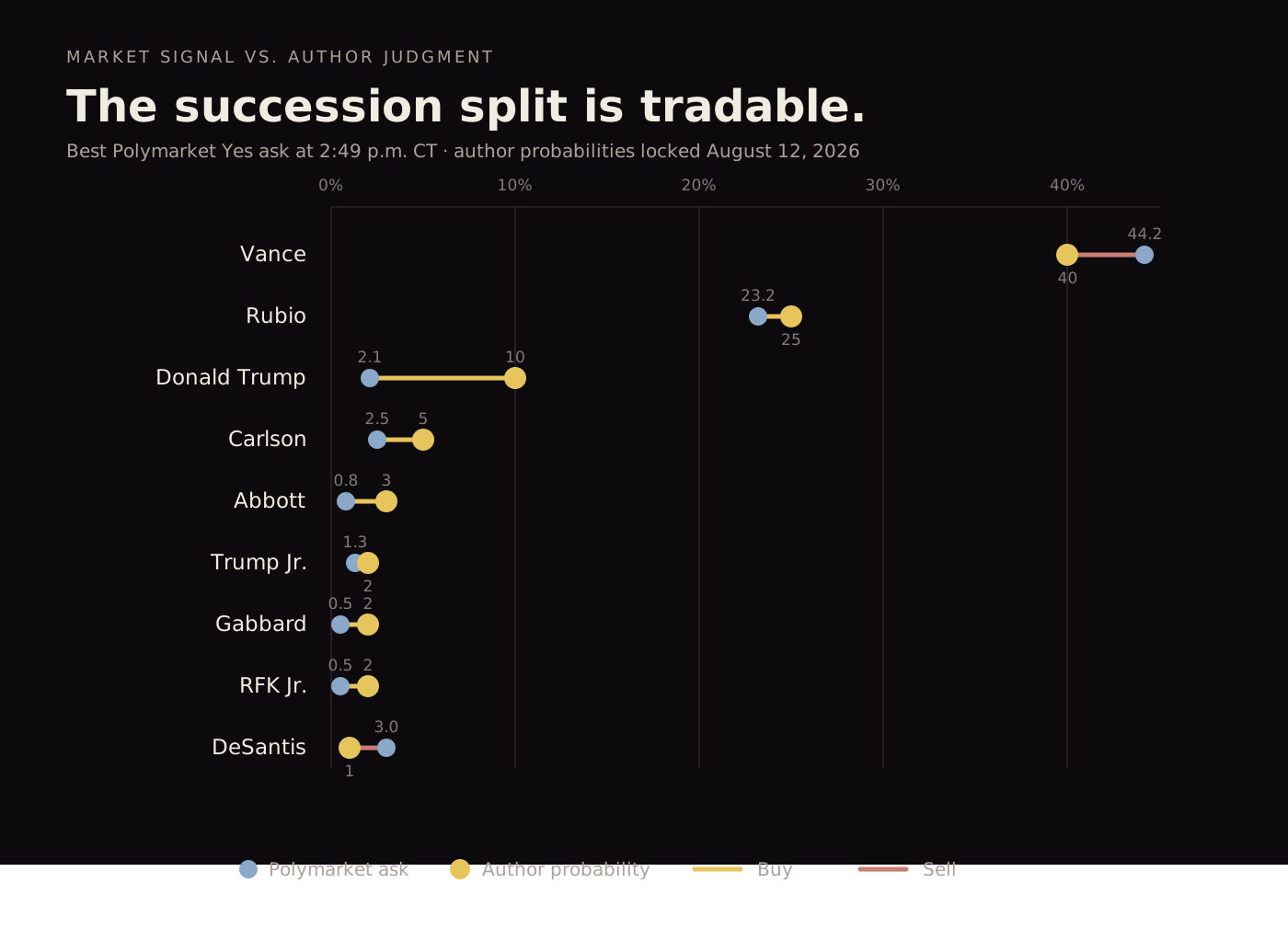
| Candidate | Polymarket ask | My probability | Edge vs. ask | Call at ask |
|---|---|---|---|---|
| J.D. Vance | 44.2¢ | 40% | −4.2 pts | Sell |
| Marco Rubio | 23.2¢ | 25% | +1.8 pts | Narrow buy |
| Donald Trump | 2.1¢ | 10% | +7.9 pts | Buy |
| Tucker Carlson | 2.5¢ | 5% | +2.5 pts | Buy |
| Greg Abbott | 0.8¢ | 3% | +2.2 pts | Buy |
| Donald Trump Jr. | 1.3¢ | 2% | +0.7 pts | Narrow buy |
| Tulsi Gabbard | 0.5¢ | 2% | +1.5 pts | Buy |
| Robert F. Kennedy Jr. | 0.5¢ | 2% | +1.5 pts | Buy |
| Ron DeSantis | 3.0¢ | 1% | −2.0 pts | Sell |
This is a strange shape for a forecast. The favorites are priced correctly. The value is in the constitutional rupture, the media insurgent, the governor almost nobody is pricing, and two former Democrats.
The shape becomes less strange once the Republican primary is understood as a succession struggle rather than a normal open race.
Henry Olsen’s four Republican electorates
In 2014, before Trump descended the escalator, Henry Olsen published one of the most useful maps of Republican presidential politics: “The Four Faces of the Republican Party.”
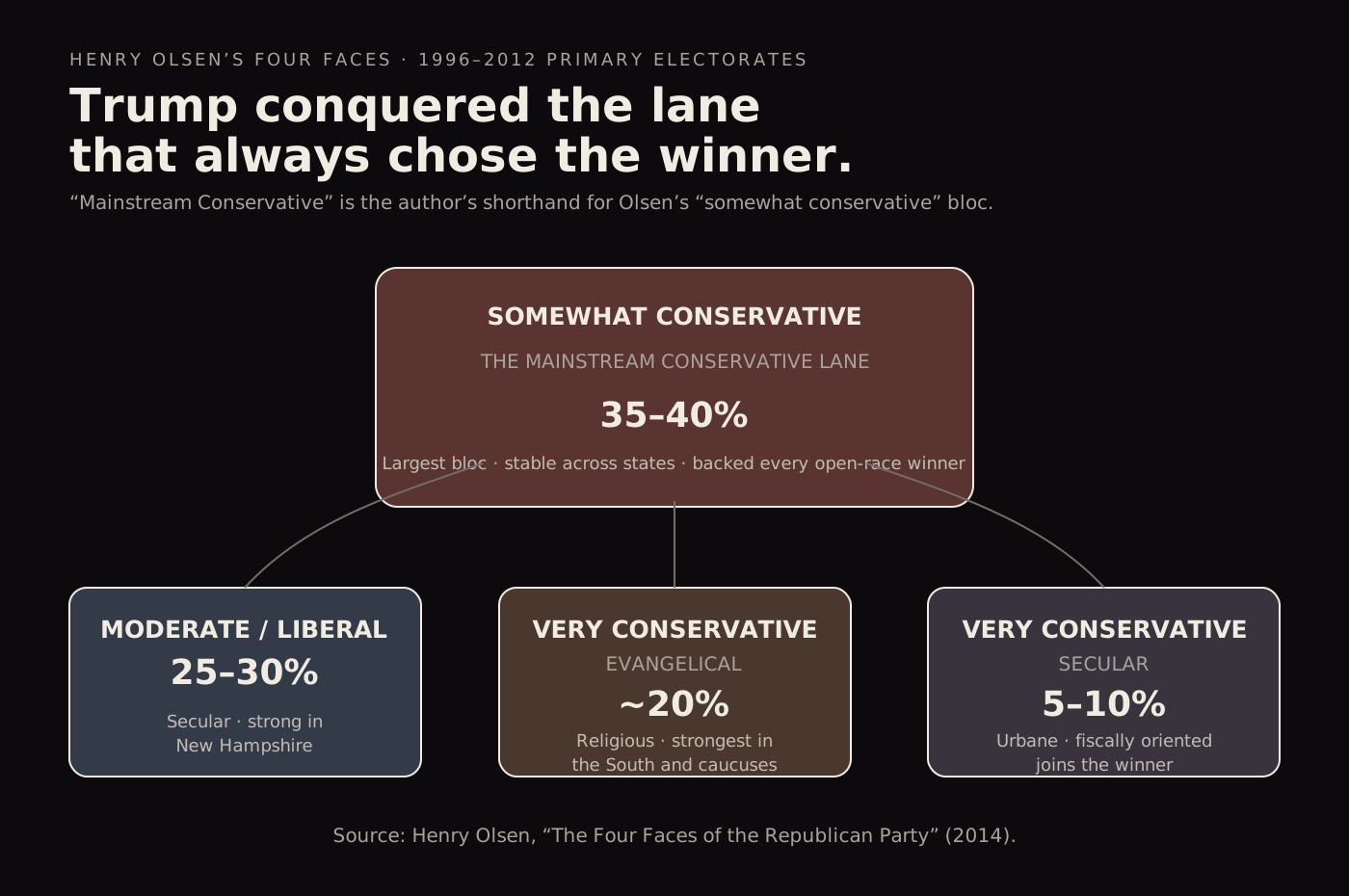
Olsen rejected the familiar establishment-versus-insurgent story. Exit and entrance polls from 1996 through 2012, he argued, revealed four durable groups.
| Olsen faction | Approximate national share | Traditional preference |
|---|---|---|
| Somewhat conservative | 35–40% | Experienced, steady, conservative without sweeping change |
| Moderate or liberal | 25–30% | Secular, less fiscally conservative, resistant to religious candidates |
| Very conservative evangelical | About 20% | Overtly religious, socially conservative, economically less doctrinaire |
| Very conservative secular | 5–10% | Urbane, fiscally oriented, ideologically conservative |
The surprising group was the largest one: somewhat conservatives. I think of it as the Mainstream Conservative lane—not “mainstream” in the sense of elite approval, but in the literal sense that it forms the broad central current of Republican primary voting.
Before Trump, Olsen’s Mainstream Conservative usually chose the next-in-line man: Bob Dole, George W. Bush, John McCain, Mitt Romney. These voters liked experience, conservative values, optimism, and a cautious temperament. Their preferred candidate won every open nomination contest Olsen studied. The small secular-conservative bloc usually lost its first choice and then joined them. Moderates often joined them to stop an evangelical candidate. Control the quiet center, then absorb the wings.
Trump appeared to be the negation of this profile. He was not even-keeled. He had no governing experience. He made conflict the organizing principle of his campaign. If Olsen’s typology were only a catalogue of candidate personalities, Trump would have destroyed it.
Instead, Trump revealed that the decisive lane was more adaptable than its old candidate profile.
How Trump became the mainstream
Trump did not win the Republican Party by remaining the candidate of its most ideological edge. He won by making himself the most legible vehicle for the largest group in the middle of its primary electorate.
The old Mainstream Conservative candidate offered continuity in temperament and policy. Trump offered continuity at a deeper emotional level: restoration.
The border would be controlled. Industry would return. America would stop losing. Social Security and Medicare would remain. The nation familiar to the voter would be recovered from institutions that had made it unrecognizable.
The means were disruptive. The promised destination was not.
That distinction is the key to Trump’s relationship with the Mainstream Conservative lane. The voter did not need to experience him as a revolutionary. He could be the disruptive instrument through which ordinary order would be restored.
Olsen’s later account moved in this direction. In 2025 he wrote that Trump assembled somewhat conservative voters without college degrees together with the Republican conservative core. Trump rejected the party’s old free-trade and immigration consensus without becoming the candidate of only one preexisting faction. He made economic populism, hard-line immigration, cultural combat, and personal loyalty components of a new center.
The 2024 primary completed the demonstration. DeSantis tried to offer Trumpism with executive competence. Nikki Haley offered a partial return to the pre-Trump coalition. Neither found a stable place from which to dislodge him. Trump was simultaneously the movement candidate, the incumbent in memory, the electability candidate for voters who had already seen him win, and the Mainstream Conservative choice.
The important sentence for 2028 is therefore not Trump captured the insurgency.
It is this:
Trump captured the Republican mainstream, then changed what mainstream Republicanism was.
His successor cannot simply win a faction and wait for consolidation. The successor must persuade the party that he is the normal continuation of Trump’s abnormal reign.
Stone’s banner and Bannon’s tribunal
Roger Stone and Steve Bannon offer two complementary theories of what happens next.
Stone’s is theatrical and personal. Trump’s celebrity, timing, stagecraft, and instinct created something that cannot be reconstructed by assembling policy positions. Asked about the party after Trump, Stone said the nominee would be the person who most effectively “carries the banner of Trumpism.”
That formulation matters. A banner is not a platform. It is a symbol carried in public, evidence that an army is still moving under the same identity.
Bannon’s theory is more doctrinal. His three tests for the succession are already visible: nonintervention abroad, economic populism at home, and war against Big Tech. Axios reported in January 2026 that Bannon had considered the architecture of a candidacy not because he expected to become president, but because a campaign could force other candidates onto that terrain.
Bannon has targeted Vance’s relationships with Peter Thiel and the technology world. He has targeted Rubio’s alignment with Israel. He has targeted Ted Cruz over both Israel and artificial-intelligence regulation. He is not merely choosing among candidates. He is building a tribunal before which candidates must prove that their Trumpism is not decorative.
Stone’s test: Carry the banner.
Bannon’s test: Prove you can carry it when it costs something.
Together they explain why the primary can remain unstable even with two overwhelming favorites. Vance and Rubio occupy the offices nearest to Trump, but neither possesses Trump’s exemption from ideological contradiction. Trump could mix restraint and force, protectionism and finance, cultural traditionalism and personal heterodoxy because the coalition attached those contradictions to him. An heir inherits the contradictions without automatically inheriting the permission.
Vance: the presumptive heir at 40
J.D. Vance has the simplest case and the most difficult job.
He is the vice president Trump selected after remaking the party. He speaks the language of postliberal economics, immigration restriction, cultural conflict, and skepticism of prolonged war more fluently than any alternative with comparable institutional standing. He connects the old Trump coalition to a younger world of national conservatives, online activists, religious conservatives, and technology patrons.
In 2022, Vance won Ohio’s Senate race with 53.0 percent and an R+6.1 all-party margin. That was a real statewide victory in a state Trump had transformed from a perennial presidential battleground into Republican terrain. It was not a landslide and it did not prove a national coalition. It gave Vance an electoral credential before Trump elevated him into the succession.
His current position is stronger than a résumé line. At the March 2026 CPAC straw poll, Vance received 53 percent to Rubio’s 35. No one else cleared two percent. CPAC attendees are not a representative sample of Republican primary voters, but the result captures the structure: Vance first, Rubio second, empty space behind them.
Trump has also privately told donors, according to The Washington Post, that “we need to elect JD.” He then publicly said it was too early to endorse. That is less a contradiction than the mechanism of the succession. Trump can strengthen Vance without surrendering the power to judge him.
The largest risk to Vance is not that Republican voters discover he is insufficiently conservative. It is that the parts of his biography that made him capable of governing the coalition become evidence that he cannot be trusted to embody it.
The technology network gives him money, personnel, and an intellectual infrastructure. It also gives Bannon a target. His foreign-policy restraint gives him credibility with the America First wing. Service inside an administration pursuing a more interventionist course forces him to demonstrate loyalty to Trump while preserving a separate claim to that wing.
Vance is the candidate best designed to inherit Trumpism as an ideology.
The question is whether Trumpism wants to become an ideology—or whether it remains a relationship with Trump.
At 40 percent, I am pricing Vance as the favorite, not the owner of the nomination.
Rubio: the alternative heir at 25
Marco Rubio’s route is the opposite.
Vance begins as the intellectual heir and must prove he can hold the entire party. Rubio begins as the adaptive institutional Republican and must prove that adaptation has become identity.
Rubio’s 2016 presidential campaign ended when Trump defeated him in Florida. The loss looked like a generational burial. Instead, Rubio survived, won reelection, joined Trump’s second administration, and became one of its most visible actors.
His statewide electoral record is stronger than Vance’s. Rubio won his 2022 Senate race with 57.7 percent and an R+16.4 all-party margin. Florida was no longer the state in which Trump had humiliated him. It had become evidence that a politician associated with the old Republican coalition could thrive inside the new one.
The 2026 CPAC movement is even more striking: Rubio rose from three percent in 2025 to 35 percent in 2026. His visibility in foreign policy, including Iran, gave Republican activists an image of executive authority. Reuters described the developing split: Vance as the more cautious voice on prolonged military involvement, Rubio as the forceful defender of Trump’s campaign.
This creates Rubio’s opportunity and his exposure.
If Trump wants a successor who appears strong, fluent, loyal, religious, and internationally commanding, Rubio can become the Mainstream Conservative choice. He is familiar without being stale, experienced without standing outside the administration, and polished without sounding like an emissary from the defeated Republican establishment.
But Bannon has identified the fracture line. Rubio’s support for Israel and hawkish foreign-policy instincts can be presented as evidence that the old party still lives beneath the Trump-era uniform. If a prolonged war turns “America First” into an accusation against the administration itself, Rubio could become its most visible defendant.
Rubio at 25 percent is not a forecast that he will challenge Vance. He has said he would not run if Vance does. It is a probability that circumstances, Trump, and Republican demand could create a challenge even when the candidate does not begin by seeking one.
Vance needs Trump’s authorization.
Rubio may need Trump’s dissatisfaction.
Trump at 10: the constitutional-crisis tail
Donald Trump is not constitutionally eligible to be elected president again. The Twenty-Second Amendment says no person may be elected to the office more than twice.
That is the present law. It is not the same thing as a zero-percent market price.
I have Trump at 10 percent because the path to 2028 passes through a political movement that has already made institutional impossibility part of its language. Bannon told Axios that he intended to “drive a Mack Truck through the 22nd Amendment.” Trump has circulated 2028 imagery and kept the idea alive even while people close to him say he is not serious.
The relevant question is not whether a conventional legal analysis permits a third election. It does not.
The question is whether an extraordinary sequence—an amendment campaign, a judicial theory, a vice-presidential workaround, a party decision to nominate first and litigate later, or some other constitutional confrontation—could move from spectacle to live political project.
Ten percent is not a claim that this is likely in the ordinary sense. It is a claim that more than one out of every hundred plausible political futures contains a Republican Party willing to test the boundary—and that Trump’s control of the Mainstream Conservative lane makes the test more dangerous than the market’s 2.1-cent price implies.
If Trump seeks the nomination, the succession is canceled.
Vance’s office becomes evidence of loyalty, not independence. Rubio’s adaptation becomes irrelevant. Bannon stops policing the heirs and resumes organizing for the king.
The market treats this as a novelty contract. I treat it as a constitutional-crisis tail with enough organized political will behind it to deserve a real number.
Tucker Carlson at five: the schism candidate
Tucker Carlson is the most important candidate who may never run.
His path does not require Trump’s permission. It requires the Republican electorate to decide that Trump’s administration betrayed the meaning of Trump’s movement.
That path has become visible. In August 2026, Carlson released a ten-point political manifesto organized around sovereignty, production, health, honesty, social order, immigration restriction, and opposition to the Iran war and Israeli influence. He described it as a basis for whatever came next, not as a formal Republican campaign.
The document matters because it converts a media revolt into a political vocabulary. Carlson can argue that Trumpism is not whatever Trump does. It is a set of commitments against war, financial extraction, surveillance, mass immigration, institutional secrecy, and cultural ugliness—and that Trump can fail those commitments.
That is a fundamentally different challenge from DeSantis’s in 2024. DeSantis tried to execute the program more competently while leaving Trump’s legitimacy intact. Carlson can challenge the legitimacy itself.
He also has something no governor can manufacture quickly: an independent relationship with millions of Republican voters. He does not need political institutions to create attention. He can define a betrayal, repeat it daily, and make candidates answer in his language.
The obstacle is obvious. Carlson has no electoral record, no governing operation, and allies who insist he is overwhelmingly unlikely to run. A schism powerful enough to make him the nominee might instead push him outside the Republican Party.
Five percent is a longshot. At a 2.5-cent ask, it is still a buy.
Abbott at three: the candidate standing behind the drama
Greg Abbott is easy to forget because his path is comparatively normal.
He is a three-term governor of Texas with an executive record built around the border, confrontation with the federal government, and administration of the country’s largest Republican state. In 2022 he won 54.8 percent and an R+10.9 all-party margin.
Abbott cannot out-Vance Vance as ideological heir or out-Rubio Rubio as national executive presence. His opening appears if both men are damaged by the administration’s internal contradictions.
In Olsen’s old map, the Mainstream Conservative lane preferred a governor who looked capable, recognizable, and safe enough to unite the party after the factions exhausted themselves. Trump changed what that lane wants, but he did not eliminate its appetite for demonstrated command.
Abbott’s border record gives a conventional governor an authentic claim to the central Trump-era issue. He can run as continuity without dynasty, experience without pre-Trump restoration, and confrontation without Tucker’s institutional rupture.
The market price of eight-tenths of a cent is too close to zero for a candidate who already governs Texas and needs fewer unprecedented events than most of the names above him.
The dynasty and the converts
Donald Trump Jr., Tulsi Gabbard, and Robert F. Kennedy Jr. describe three ways Trump’s coalition could remain Trumpian without choosing either principal heir.
Trump Jr. has the name, the audience, and a direct relationship with the movement’s activist culture. His path is dynastic but not automatic. The family identity supplies authenticity; the absence of elected office or executive responsibility leaves him without evidence that he can carry the coalition outside his father’s presence. Two percent is enough to price the possibility that the movement prefers bloodline to designated succession.
Gabbard and Kennedy are more revealing. Both became nationally important Democrats before becoming members of Trump’s governing coalition. Their presence in a Republican nomination book is not a curiosity at the edge of the party. It is evidence about what the party has become.
Trumpism is unusually capable of treating conversion as authority. A convert can testify that the opposing order was corrupt from the inside. Gabbard can speak through military service, intelligence, civil liberties, and a break with the Democratic establishment. Kennedy can speak through health, institutional distrust, environmental identity, and a family name once synonymous with Democratic politics.
Gabbard’s last congressional race, as a Democrat in Hawaii’s 2nd District in 2018, ended in a 77.4-percent victory. That does not forecast a Republican presidential electorate. It demonstrates that she is not merely a media figure; she has run, won, and built a political identity before changing parties.
Kennedy’s electoral path is less conventional. His value comes from an audience organized around distrust of institutions more than from a previous Republican constituency.
At half a cent each, I do not need either conversion to be probable. I need it to be more plausible than one chance in 200.
The electoral résumés are unequal
The succession field combines candidates who have won enormous electorates with candidates who have never appeared on a general-election ballot.
| Candidate | Latest relevant general election | Vote share | All-party margin |
|---|---|---|---|
| Donald Trump | President, national, 2024 | 49.8% | R+1.5 |
| J.D. Vance | Ohio Senate, 2022 | 53.0% | R+6.1 |
| Marco Rubio | Florida Senate, 2022 | 57.7% | R+16.4 |
| Greg Abbott | Texas governor, 2022 | 54.8% | R+10.9 |
| Tulsi Gabbard | Hawaii 2nd District, 2018 | 77.4% | D+54.8 |
| Tucker Carlson | None | — | — |
| Donald Trump Jr. | None | — | — |
| Robert F. Kennedy Jr. | No general-election win | — | — |
The table does not rank nomination strength. Trump’s national margin was smaller than Rubio’s Florida margin, but Trump created the electorate Rubio must now inherit. Tucker has never won a precinct and still possesses a path Abbott cannot copy.
Electoral history matters here as a test of different things.
Vance has proved he can win the state that best represents Trump’s Midwestern realignment. Rubio has proved he can produce a large margin in the party’s new Florida stronghold. Abbott has proved durability across three Texas races. Gabbard has proved political fluency in an electorate almost entirely unlike the Republican primary.
What none has proved is that Trump’s coalition can be transferred.
Five ways the race can resolve
The book becomes easier to read as a set of succession mechanisms.
| Resolution | What has to happen | Candidate most helped |
|---|---|---|
| Designated inheritance | Trump settles on an heir and the party accepts the designation | Vance |
| Alternative inheritance | Vance weakens; Trump or the party seeks a more institutional successor | Rubio |
| Constitutional confrontation | Trump turns third-term imagery into an actual nomination project | Trump |
| Doctrinal schism | America First activists decide the administration betrayed the movement | Carlson |
| Exhaustion and fallback | The heirs damage one another and voters seek an executive outside the fight | Abbott / field |
Vance’s 40 percent dominates the first path. Rubio’s 25 percent dominates the second. Trump’s 10 percent is almost entirely the third. Carlson’s five percent is concentrated in the fourth. Abbott’s three percent is a bet on the fifth.
Trump Jr., Gabbard, and Kennedy can rise in several paths, but each requires an unusual failure of the principal succession.
This is why the field does not feel like 2016. In 2016, many candidates represented pieces of a party waiting to discover its center. In 2028, candidates will compete for permission to occupy a center already bearing one man’s name.
The king, the banner, and the lane
Olsen’s typology explains the electoral architecture. Stone explains the symbolic requirement. Bannon explains the ideological punishment. Trump explains why none of these can be separated.
The Mainstream Conservative lane once chose the candidate who could calm the party after its factions spoke. Trump taught it to experience conflict itself as a form of stability: the same fighter, the same enemies, the same promise of restoration.
Vance is the best-positioned candidate to preserve that synthesis. Rubio is the best-positioned candidate to inherit it if Republican voters decide synthesis means command more than doctrine. Carlson is the candidate who can declare the inheritance fraudulent. Abbott is the candidate who can wait for the declaration to consume everyone else.
And Trump remains the person who can make the whole exercise irrelevant.
My book therefore contains a paradox.
Vance and Rubio dominate because the visible succession really is that concentrated. The market leans too heavily toward Vance within that pairing, while the longshots remain underpriced because the succession may not remain visible, orderly, or constitutional.
The Republican nominee in 2028 will probably be J.D. Vance or Marco Rubio.
But the person who wins will not merely have defeated the other candidates.
He—or Trump himself—will have answered three different demands at once:
Carry Stone’s banner.
Pass Bannon’s tribunal.
And persuade the quiet Republican center that, after Donald Trump, he is what normal looks like.