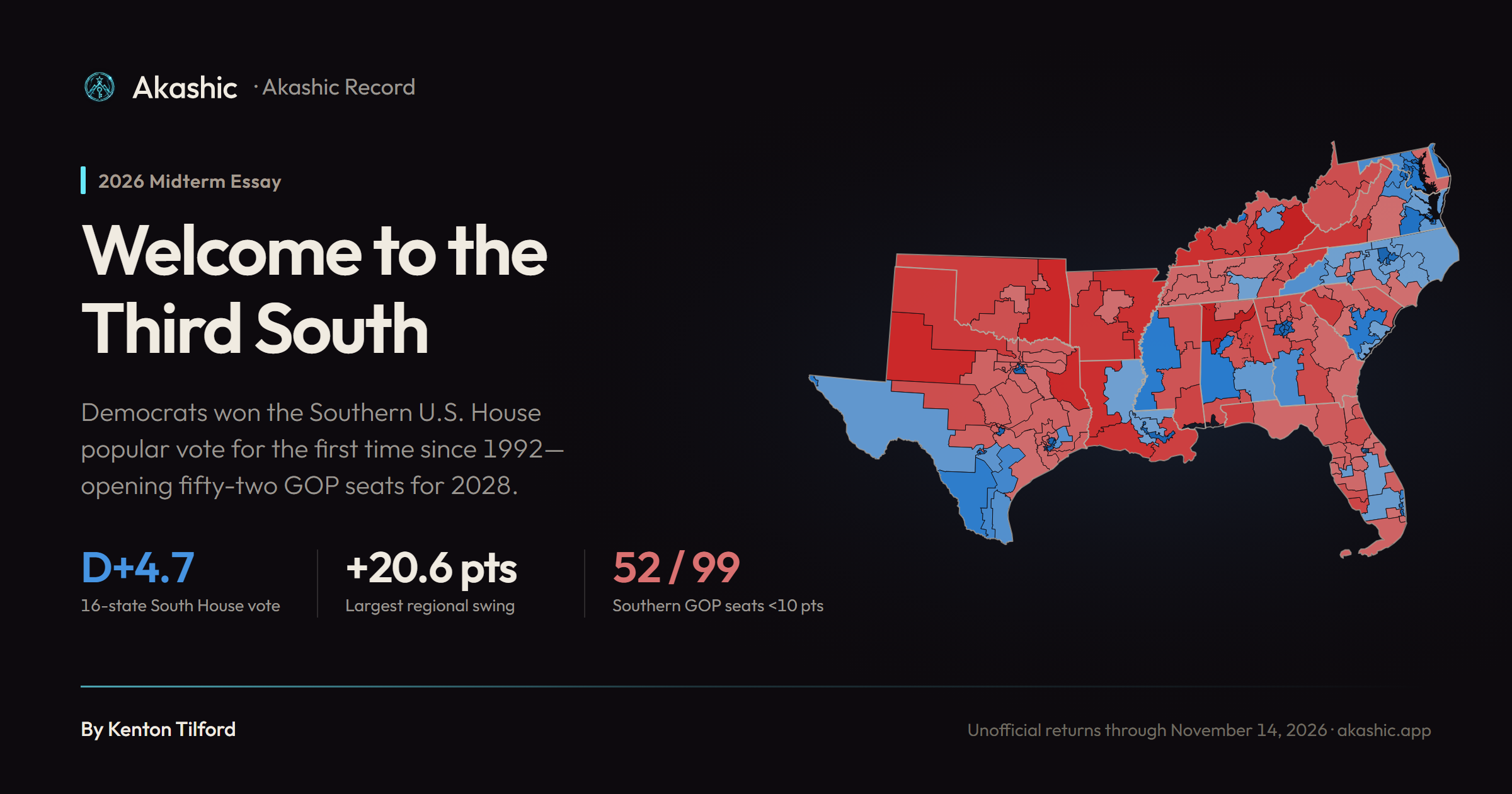
Democrats just won the Southern U.S. House popular vote for the first time since 1992. How tariffs, the gutting of the Voting Rights Act, and a booming Sunbelt broke a thirty-four-year Republican streak—and opened the 2028 map.
In 2014, I worked on Senator Mary Landrieu’s re-election campaign in Louisiana, watching the last of the old conservative Southern Democratic coalition give way. Four years later, I knocked on doors and mapped precincts in southern West Virginia for Richard Ojeda, a retired Army paratrooper running as a fiery economic populist in a coalfield district Donald Trump had carried by nearly fifty points. Both races ended in double-digit defeats, and out of losses like them hardened Washington’s settled rule: outside a handful of blue metro enclaves, the South was gone.
Then came November 3, 2026. In North Carolina’s Sandhills—stretching from Fort Bragg toward the booming towns south of the Research Triangle—that same Richard Ojeda unseated Richard Hudson, the chair of House Republicans’ own campaign arm, flipping a Trump +15.8 district by 2.3 points (51.1% to 48.9%) in unofficial returns. Across North Carolina, a congressional map engineered for an 11–3 Republican lock turned upside down into an 11–3 Democratic lead, as Democrats carried the statewide House vote by 15.2 points (57.0% to 41.8%) and former Governor Roy Cooper rolled to a 19.6-point U.S. Senate victory (58.7% to 39.1%).
Most post-election commentary treats November 2026 as a routine midterm bounce against the party in the White House. That misses the deeper shift: we are watching the arrival of the Third South. The First South (1877–1965) enforced a Jim Crow agrarian order through one-party Democratic rule. The Second South (1968–2024) rebuilt conservative dominance inside the Republican Party—first at the presidential level, then in Congress after 1992, and finally down the ballot by 2014. It welcomed corporate relocations and global investment, yet assumed it could freeze Southern politics in cultural grievance and minority vote dilution.
Today’s South outgrew that bargain. Anchored by fast-growing metros across Texas, Georgia, North Carolina, and South Carolina, the region is now America’s commercial and demographic engine—young, multiracial, entrepreneurial, wired into global trade, and still deeply churched without wanting a culture war. When Washington Republicans turned toward sweeping tariffs and fresh attacks on the Voting Rights Act, they collided head-on with the economy and electorate their own Sunbelt boom had helped create. In 2026, that new South broke through.
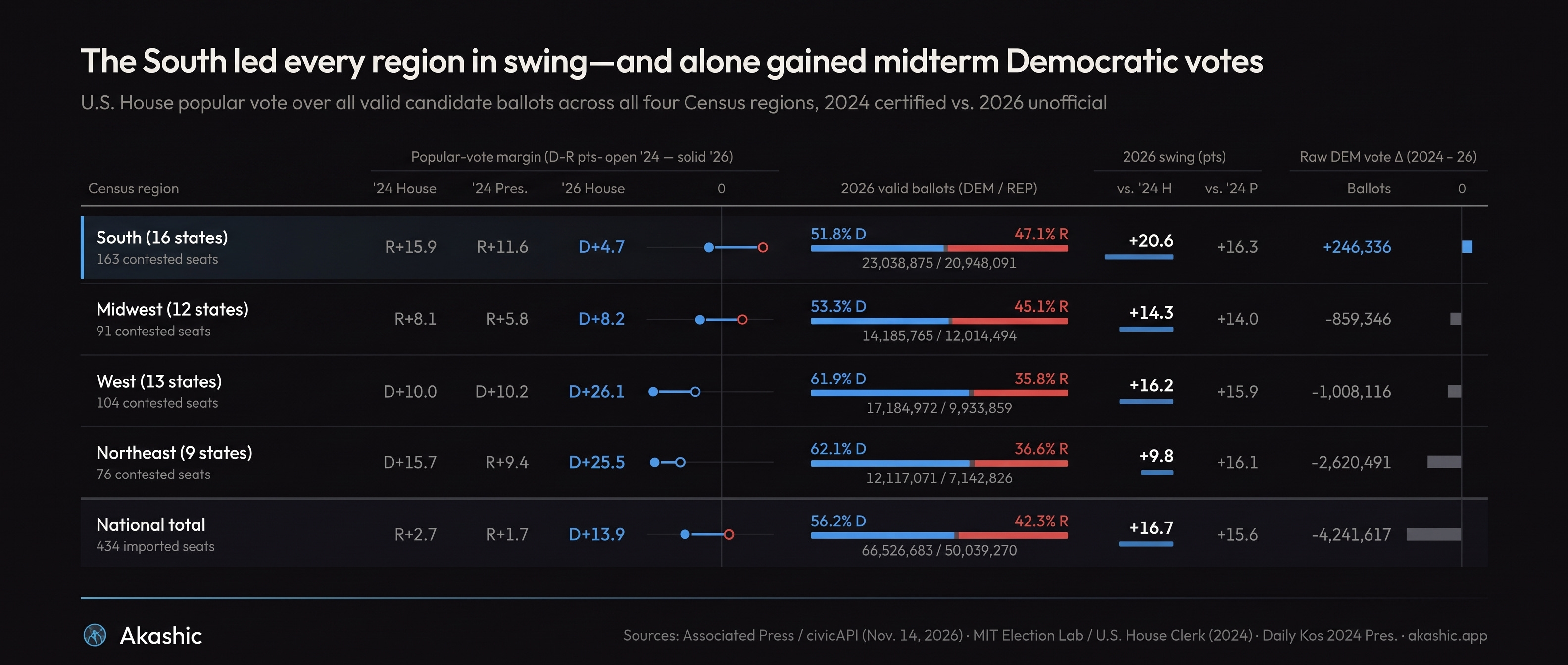
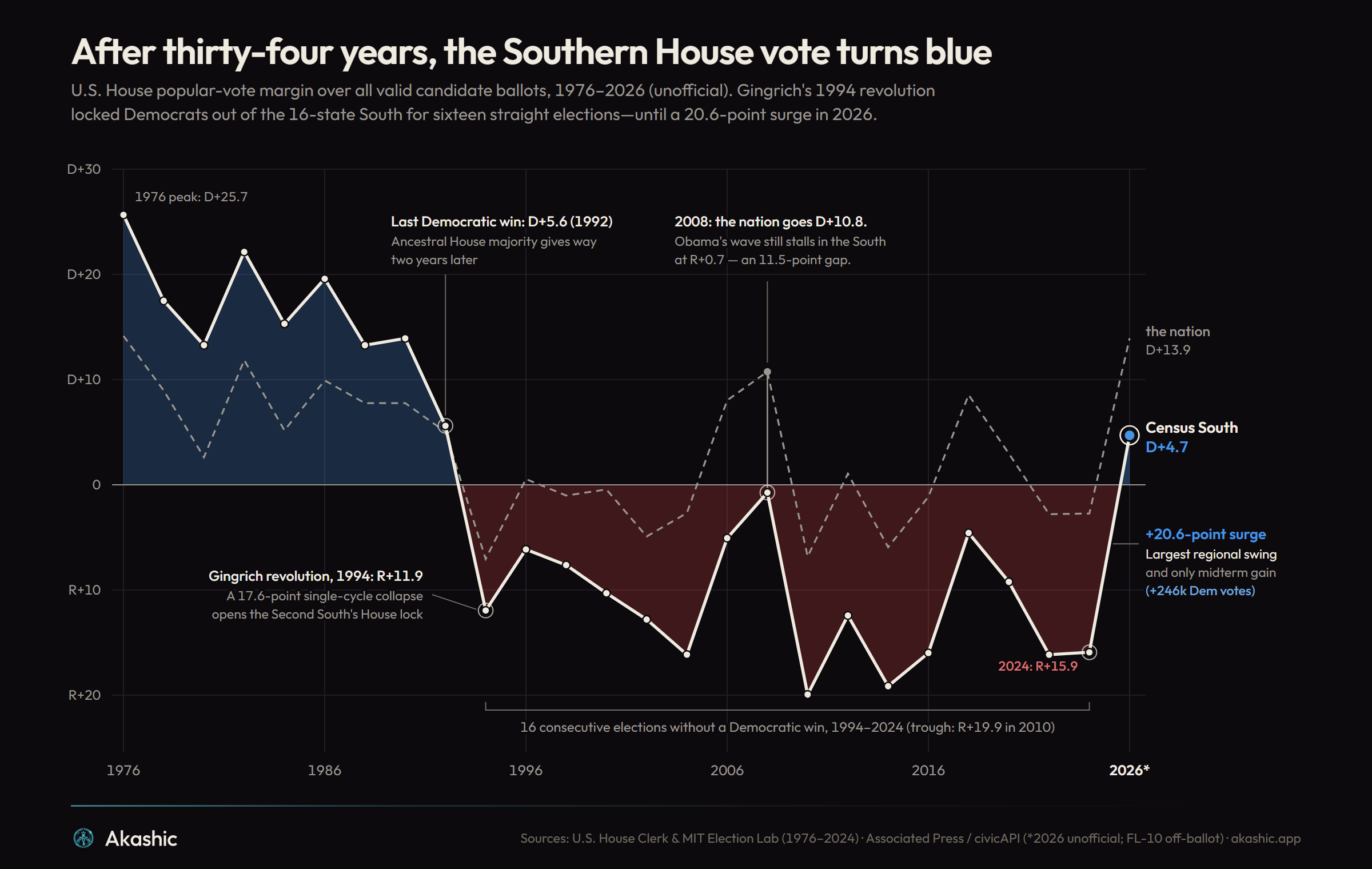
The clearest proof sits in the U.S. House popular vote. For the first time since 1992, Democrats won the House popular vote across the South—carrying the sixteen Census South states by 4.7 points (51.8% to 47.1% across 44.5 million unofficial valid votes). That snapped a sixteen-election Republican streak stretching back to the 1994 Gingrich revolution—a wall that had held through the 2006 Democratic rout, Barack Obama’s 2008 wave (when Republicans still edged the Southern House vote by 0.7 points), and 2018 (when they held it by 4.6). Comparing all four Census regions from 2024 to 2026 shows where the map moved fastest: the South delivered the largest swing of any region in America, surging 20.6 points from the 2024 U.S. House vote and running 16.3 points ahead of the 2024 presidential baseline. Even more striking, while midterm drop-off trimmed raw Democratic House totals in the Northeast, Midwest, and West, the South was the only region where Democrats cast more House votes in a midterm (23.0 million) than in a presidential year two Novembers earlier (22.8 million)—adding nearly a quarter-million Democratic ballots regionwide against normal midterm gravity.
Regional U.S. House popular vote over all valid candidate ballots (2024 certified vs. November 14, 2026 unofficial returns).
Fifty years of U.S. House popular-vote margins across the sixteen Census South states and the nation (1976–2026 unofficial).
Why 2024 was 1928 — and 2026 is 1930
In The Future of American Politics (1952), Samuel Lubell argued that Franklin Roosevelt’s New Deal majority did not begin with the Great Depression. “Before the Roosevelt Revolution,” Lubell wrote, “there was an Al Smith Revolution.” On the surface, November 1928 looked like permanent Republican hegemony: Herbert Hoover crushed Smith in a landslide and even cracked parts of the old Democratic Solid South. Looking underneath the national topline at ward-by-ward returns and registration rolls, however, Lubell spotted a demographic earthquake. As the American-born children of Catholic, Jewish, and Southern and Eastern European immigrants came of age and entered the electorate, Smith became the first twentieth-century Democrat to win a majority of the country’s twelve largest cities—flipping urban strongholds that Republicans had swept four and eight years earlier.
Demography laid the dry timber in 1928; Republican overreach lit the match in 1930. Rather than adapting to an urbanizing, trade-linked consumer society, Hoover and a protectionist Congress clung to cultural orthodoxy on Prohibition and passed the June 1930 Smoot-Hawley Tariff, driving up prices and choking commerce as the economy stalled. Five months later, in the November 1930 midterms, the emerging Smith electorate stayed engaged while Republican cushions collapsed: Democrats gained 52 House seats and eight Senate seats—wiping out Hoover’s governing margin and handing the House gavel to Texas Democrat John Nance Garner when the 72nd Congress convened—while Roosevelt turned his narrow 1928 New York gubernatorial survival into a 725,000-vote reelection rout. What looked in 1928 like an isolated urban anomaly became, by 1930, the spine of a national realignment.
2024 and 2026 ran that exact play across a geographically inverted map. Just as Hoover made eye-catching gains in the old South while losing purchase in America’s fastest-growing Northern cities, Donald Trump reclaimed the White House in 2024 and chipped into legacy Northern urban strongholds even as the early tremors of a Southern counter-coalition registered underneath. Two decades of domestic migration, corporate relocation, and generational turnover had quietly transformed Sunbelt metros and booming exurban corridors into a younger, multiracial, trade-exposed electorate. Even in a Republican presidential year, those places flashed unmistakable counter-trend signals—from metro Atlanta suburbs bucking the national swing, to North Carolina electing a Democratic governor and attorney general on Trump’s own ballot, to Senate candidates like Ruben Gallego in Arizona and Colin Allred in Texas running well ahead of the national ticket.
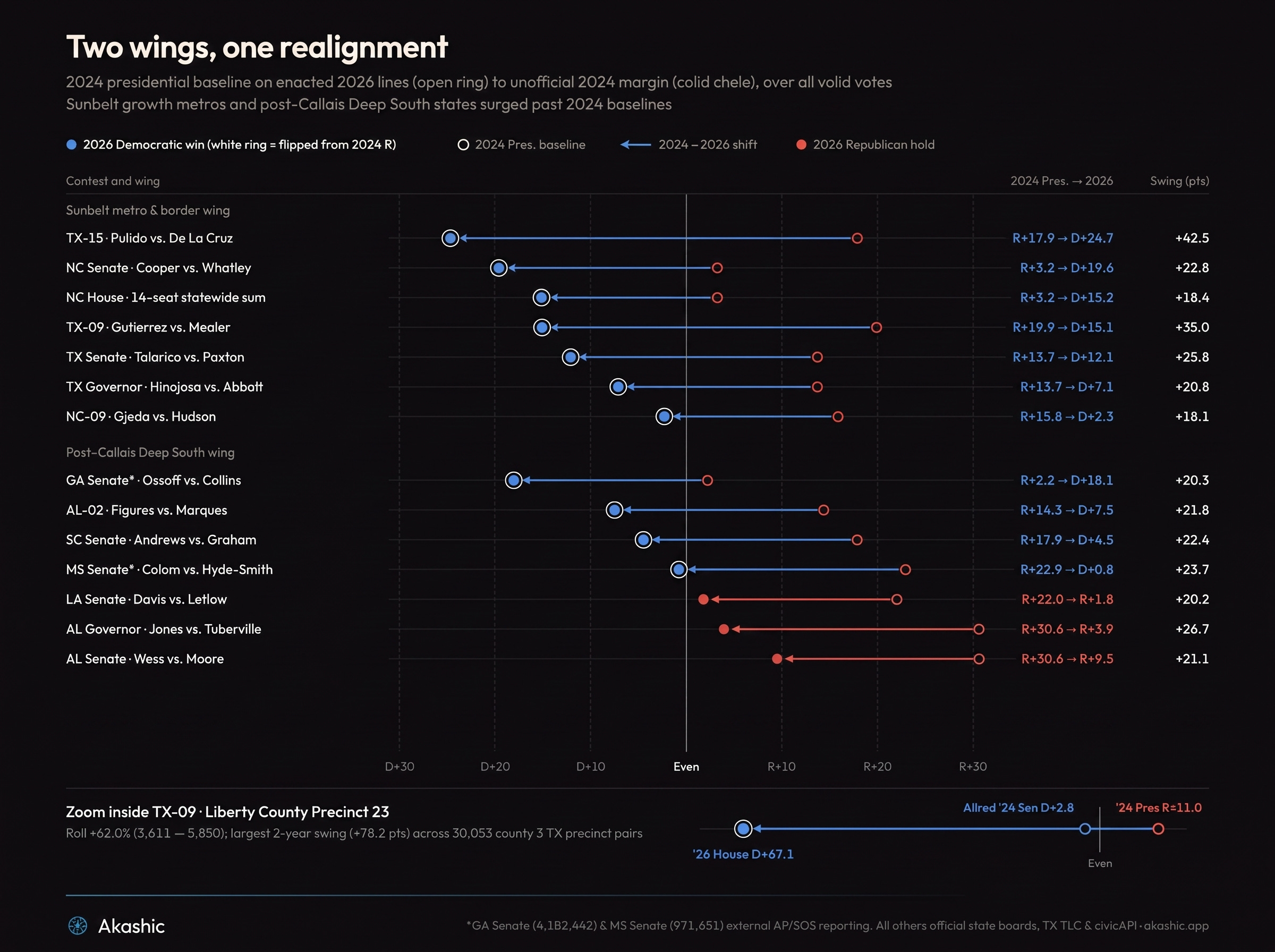
Take TX-09 northeast of Houston, which Texas Republicans redrew in 2025 to carve out a safe Republican pickup. Under those new lines, Trump had carried the district in 2024 by 19.9 points over Kamala Harris (59.5% to 39.6%). Yet on that same 2024 ballot, Allred ran 8.2 points ahead of Harris district-wide, cutting the Republican margin to 11.6 points. Deeper inside the district, in booming Liberty County Precinct 23—home to the fast-growing working-class subdivisions around Colony Ridge and Santa Fe—Trump won by 11.0 points (741 votes to 593), while Allred carried the precinct outright by 2.8 points (643 votes to Ted Cruz’s 607). That single-precinct split was 2024’s Al Smith tell.
Over the next two years—just like the surging immigrant-ward rolls Lubell tracked between 1928 and 1930—Precinct 23’s voter roll jumped 62.0%, climbing from 3,611 registered voters to 5,850 while turnout held steady at 37.2%. On November 3, 2026, Democrat Leticia Gutierrez overwhelmed Republican Alex Mealer there 1,755 votes to 346 (83.5% to 16.5%)—a 67.1-point rout that marked a 78.1-point swing from Trump’s 2024 margin, alongside a 66.8-point Senate-to-Senate surge. Across 11,952 Texas precinct comparisons since 2012 and 18,101 U.S. county comparisons since 2000—every consecutive presidential pair casting at least 1,000 ballots—not a single one shifted by 78 points. Zooming out to the full district, that supposedly safe Republican seat flipped in a landslide: Gutierrez carried TX-09 by 15.1 points (57.6% to 42.4% in official county canvasses), a 35.0-point swing from 2024.
That tremor ran across all of Texas, ending a thirty-two-year Democratic statewide drought in one night: state representative and Presbyterian seminarian James Talarico defeated Ken Paxton for U.S. Senate by 12.1 points—nearly 1.2 million votes (55.1% to 43.0%)—while Gina Hinojosa unseated three-term Governor Greg Abbott by 7.1 points (52.8% to 45.7%). Along the Rio Grande, the 2024 rightward lurch reversed with equal force across four border districts Trump had carried by ten to eighteen points: Tejano star Bobby Pulido unseated Republican Rep. Monica De La Cruz in TX-15 by 24.7 points (62.3% to 37.7%), Katy Padilla Stout flipped sprawling TX-23 by 8.2 points, and Democrats Henry Cuellar and Vicente Gonzalez romped by 36.1 and 15.8 points in TX-28 and TX-34.
Bryan’s grievance, McKinley’s tariffs, and the Callais boomerang
Just as Smoot-Hawley and Prohibition orthodoxy turned 1928’s quiet urban cracks into 1930’s rout, two policy shocks broke the Southern map wide open in 2026. The first was a bizarre Gilded Age mash-up. Donald Trump idolizes William McKinley as his tariff hero while campaigning in the populist grievance style of McKinley’s 1896 rival, William Jennings Bryan—even though Bryan himself condemned protective tariffs for picking working families’ pockets to enrich well-connected insiders. Worse for Republicans, Trump remembered 1896 McKinley and forgot 1890 McKinley: the Ohio congressman whose October 1890 tariff pushed average duties near 50% just weeks before voters cut House Republicans nearly in half, from 171 seats to 88, and threw McKinley out of Congress. Pairing Bryanite cultural grievance with McKinley-scale consumer taxes squeezed Sunbelt ports, auto plants, Gulf refineries, and working-class grocery bills all at once.
Second came the Supreme Court’s April 29, 2026, 6–3 decision in Louisiana v. Callais, gutting Section 2 of the Voting Rights Act and clearing the way to dismantle majority-Black districts. Stripping away federal voting-rights protections months before a midterm wave boomeranged on its architects, as Black churches, HBCU campuses, and local organizers mobilized across the Deep South in an act of collective self-defense:
South Carolina and Mississippi flipped blue for U.S. Senate: In South Carolina, pediatric physician Annie Andrews defeated appointed Republican Senator Darline Graham by 4.5 points (51.1% to 46.6%)—turning a South Carolina Senate seat Democratic for the first time since 1998 and becoming the state’s first woman senator, even as Nancy Lacore flipped coastal SC-01 by 1.0 point and 25-year-old Democrat Zyon Khalifa held Republican Rep. Joe Wilson—infamous for shouting “You lie!” at Barack Obama during a 2009 joint address to Congress—to a sub-one-point survival in SC-02 across the Columbia suburbs. In Mississippi, District Attorney Scott Colom unseated Republican incumbent Cindy Hyde-Smith by 0.8 points (49.3% to 48.6%)—becoming Mississippi’s first Democratic U.S. Senator since 1982 and the state’s first Black statewide general-election winner since Reconstruction.
Georgia delivered an eighteen-point Senate blowout: Senator Jon Ossoff crushed Republican Rep. Mike Collins by 18.1 points (59.0% to 41.0%—a landslide of more than 755,000 votes), while Georgia Democrats carried the statewide U.S. House popular vote by 12.4 points (56.2% to 43.8%).
Alabama broke a Trump +14 gerrymander and pulled statewide races into single digits: After Callais emboldened Republicans to redraw AL-02 into a Trump +14.3 district explicitly to oust Shomari Figures, Figures won comfortably anyway by 7.5 points (53.8% to 46.2% over Rhett Marques, a 21.8-point swing). Statewide, former Senator Doug Jones came within 3.9 points of Tommy Tuberville in the governor’s race (47.9% to 51.8%), and Democrat Everett Wess pulled Alabama’s U.S. Senate contest into single digits, trailing Rep. Barry Moore by 9.5 points (45.2% to 54.7%).
Black turnout in Louisiana nearly toppled a prized GOP Senate recruit: As Black voters climbed to roughly 32% to 34% of early ballots—Louisiana’s highest Black share of early voting since 2008—Jamie Davis, an underfunded third-generation Delta farmer and former local official, came within 1.8 points (49.1% to 50.9%) of defeating well-financed Republican Congresswoman Julia Letlow for U.S. Senate.
Shifts from 2024 presidential baselines on enacted 2026 lines to unofficial 2026 margins across Sunbelt metro, border, and post-Callais Deep South races, plus Liberty County Precinct 23.
Pulpit, paycheck, and why Texas isn’t Florida
How did Democrats like Talarico, Pulido, and Ossoff connect across churchgoing towns and booming metro suburbs without the coastal condescension that doomed past campaigns? Instead of lecturing Southern voters in seminar-room jargon, leaders like Talarico and Georgia’s Senator Raphael Warnock speak a native moral vocabulary of neighborliness, family stewardship, and an honest day’s pay—bridging historic Black churches (still home to 60% of Black churchgoers, per Pew Research), fast-growing multiracial congregations (now 25%), and suburban pews tired of partisan sermons. Skeptics will point to uniquely damaged Republican nominees like Ken Paxton in Texas, whose years of corruption scandals and bitter primary runoff ousting John Cornyn certainly widened Talarico’s twelve-point margin. Yet candidate quality cannot explain away what happened next door or down the ballot: in Georgia, Ossoff buried a conventional two-term House conservative in Mike Collins by 18.1 points, while across the region this coalition unseated entrenched Republican incumbents—three-term Governor Greg Abbott on Paxton’s own Texas ballot, Senator Cindy Hyde-Smith, NRCC Chair Richard Hudson, and Rep. Monica De La Cruz.
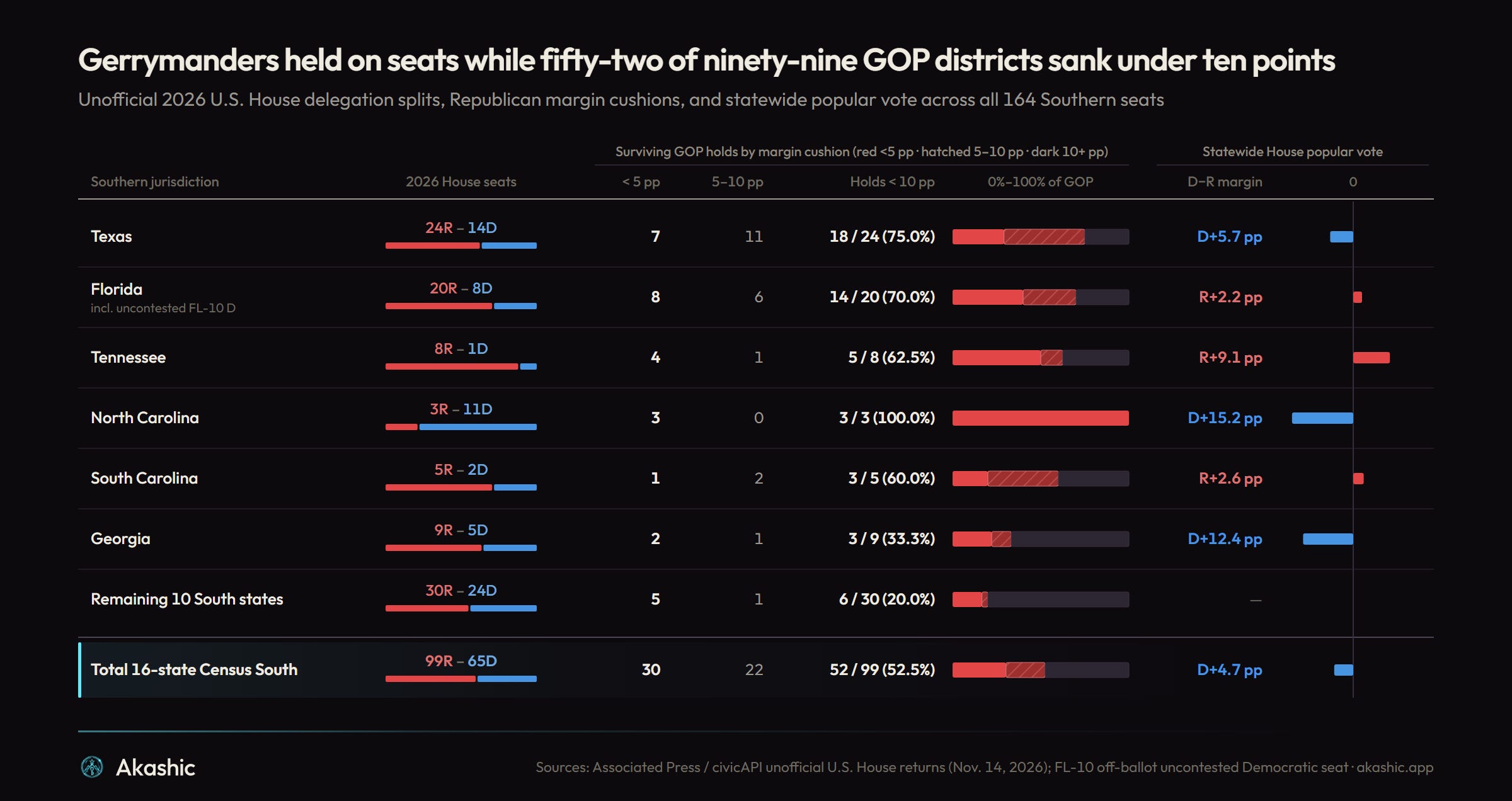
Even where Republican gerrymanders held the line on seats, they did so by hollowing out the map underneath. Republicans clung to a 24–14 U.S. House majority in Texas despite losing the statewide House vote by 5.7 points (52.6% to 46.9%), and kept a 9–5 edge in Georgia while losing the House vote there by 12.4 points. In Tennessee, aggressive post-Callais cracking split Memphis and flipped long-Democratic TN-09, where Republican Brent Taylor edged past state Rep. Justin Pearson by 1.1 points (49.6% to 48.5%). Yet scattering Memphis voters into neighboring districts stretched Tennessee’s map thin: five Republican holds sank below 5.3 points, and GOP-held TN-04 tipped into a 0.1-point Democratic lead. Gerrymandering saved seats in 2026 only by stretching once-safe Republican districts to the breaking point.
Comparing Texas with Florida sharpens what actually powers the Third South. Even in a wave that pulled fourteen of Florida’s twenty Republican House seats under 10 points (and four under a single point), Florida still stayed Republican statewide—by 1.3 points for governor (50.0% to 48.7%), 2.9 points in its special Senate race (50.9% to 48.0%), and 2.2 points across its 27 contested House seats. That divergence reflects a different political economy: Florida leans heavily on older retirees living off pensions and home equity alongside South Florida’s Cold War diaspora coalition, with far shallower ancestral roots in the Democratic Party than Texas’s generations-deep LBJ and Tejano tradition. Where Texas, Georgia, and the Carolinas run on young, working-age families tied to trade, logistics, and manufacturing, much of Florida’s electorate sits insulated from paycheck and tariff shocks alike.
Fifty-two seats under ten points — and whether 2026 becomes 1932
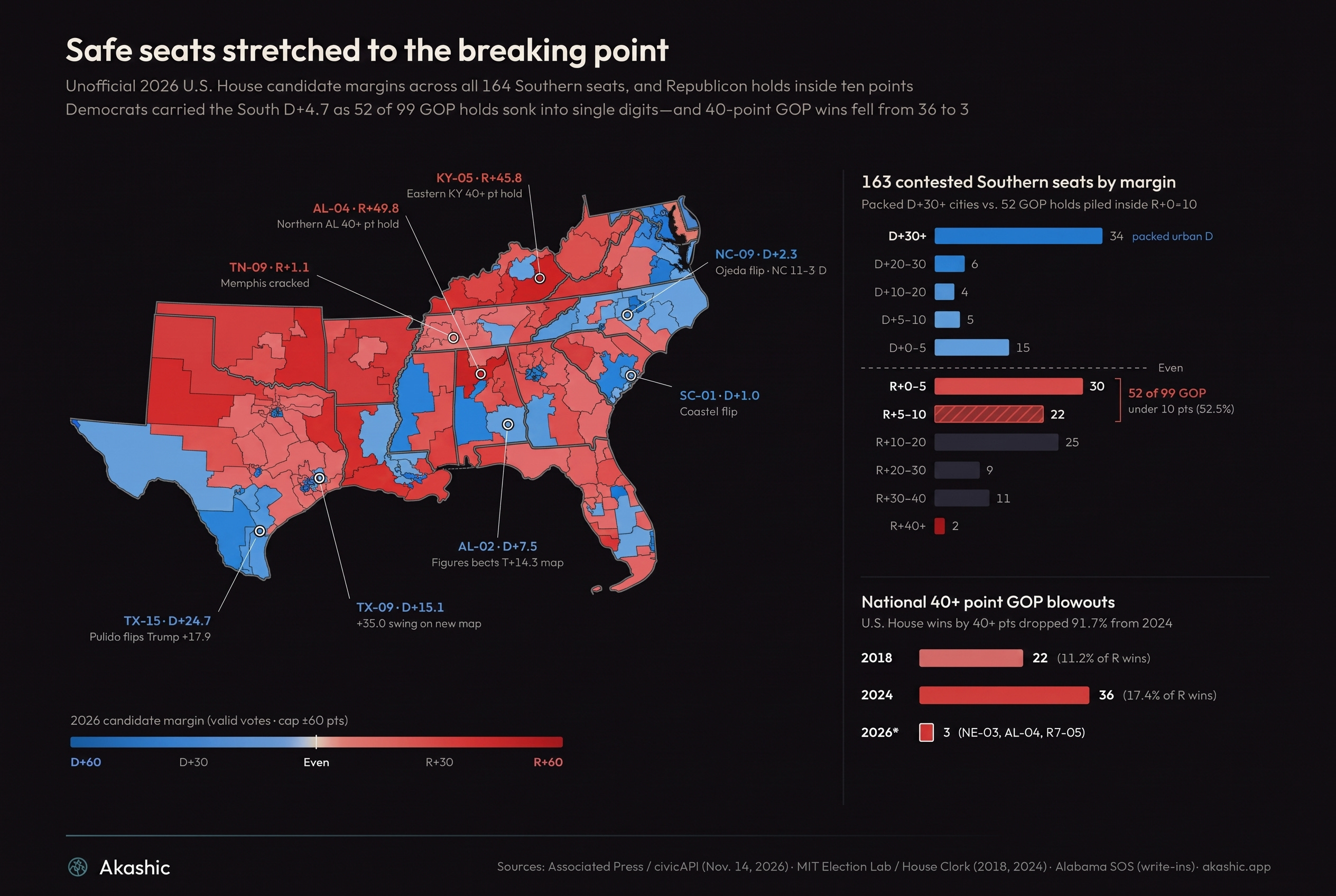
Look at the structural map left standing after November 3. Across the 434 U.S. House races on the ballot (118.4 million unofficial votes), Democrats led nationally by 13.9 points (56.2% to 42.3%—and by 12.0 points across the 408 seats contested by both major parties). Nationally, 40-point Republican House blowouts collapsed from 36 in 2024 (and 22 in 2018) to just three: rural Nebraska’s NE-03 (+51.0 points), northern Alabama’s AL-04 (+49.8), and eastern Kentucky’s KY-05 (+45.8). Inside the sixteen Census South states, more than half of all remaining Republican House seats—52 of 99, including 30 decided by under 5 points—now sit in single digits: three-quarters of the GOP delegation in Texas (18 of 24), seven in ten in Florida (14 of 20), five of eight in Tennessee, and every surviving Republican seat in North Carolina (all three under 1.8 points). Gerrymanders engineered for a double-digit Republican South survived 2026 only by burning through their cushions—leaving dozens of incumbents exposed heading into 2028.
Southern U.S. House delegation leads, surviving GOP margin cushions (<5 pp, 5–10 pp, 10+ pp), and statewide House popular vote.
All 164 Southern congressional districts by 2026 candidate margin, paired with the 163-seat margin histogram (52 of 99 GOP holds under 10 points) and national 40-point GOP blowouts falling from 36 to 3.
Winning a tariff-backlash midterm is not yet a lasting majority: 1890 ended with Democrats nominating Bryan and losing the presidency for a generation, while 1930 launched Franklin Roosevelt’s New Deal. Lubell’s framework explains why those two midterm waves diverged. After routing McKinley’s party in 1890, Democrats misread a consumer revolt against tariffs as license for an inward-looking agrarian crusade in 1896, alienating the growing commercial towns and industrial workers whose votes were needed to govern. Between 1930 and 1932, by contrast, Democrats consolidated the ascending metropolitan electorate that Al Smith had awakened in 1928—turning newly registered cohorts and tariff-battered split-ticket voters into habitual partisans.
Institutional rules now make a repeat of 1896’s mistake far harder. Under the 2028 presidential nominating calendar approved by the Democratic National Committee in August 2026, Southern voters bookend the entire six-state early window: South Carolina leads off the nation on January 22, 2028—ahead of Nevada (February 1), New Hampshire (February 8), New Mexico (February 15), and Michigan (February 22)—before newly elevated Virginia closes out the pre–Super Tuesday slate on February 29, handing the race directly into a Southern-heavy Super Tuesday. Instead of letting nearly all-white Northern contests set the party’s ideological tone before the South casts a ballot, any 2028 Democratic contender must now open in South Carolina’s Black churches and fast-growing Lowcountry and Upstate towns, compete across Latino-heavy Western battlegrounds, and finish February across Virginia’s defense corridors, federal workforce, and booming suburbs—forcing the next nominee to speak the Third South’s language from day one.
By a striking historical symmetry, the 52 House seats Democrats gained nationwide in November 1930 match the exact number of Southern Republican districts—52 of 99—now sitting in single digits heading into 2028. In Lubell’s terms, 2024 cracked the Second South’s foundation in fast-growing metro suburbs and working-class exurbs, and 2026’s collision over tariffs and Callais broke its thirty-four-year congressional lock. Whether 2026 fades like 1890 or endures like 1930 into a governing majority will be decided across those fifty-two districts—and the presidency—by whichever party builds for the young, trade-wired, multiracial South that has already arrived.
Method, briefly. All candidate vote shares and margins are computed over total valid candidate ballots recorded for each race, preserving independent, Libertarian, Green, and declared write-in candidates alongside Democratic and Republican nominees. All 2026 figures reflect pre-certification returns current as of November 14, 2026 for U.S. House contests (Associated Press and civicAPI unofficial totals across 434 districts, with uncontested FL-10 off-ballot under Florida law), November 13, 2026 for county-summed TX-09 and Liberty County Precinct 23 returns (official Harris and Liberty County canvasses paired with Texas Legislative Council 2024 precinct reaggregations), and November 7, 2026 for state election-board captures in Texas, North Carolina, South Carolina, Alabama, Louisiana, and Florida. Georgia Senate (4,182,642 printed-ballot votes) and Mississippi Senate (971,651 valid votes) incorporate Associated Press and state reporting pending full county write-in reconciliation. Historical 1992–2024 House comparisons draw on certified U.S. House Clerk and MIT Election Data and Science Lab records supplemented by Louisiana open-primary and Alaska first-round Democratic totals, alongside Daily Kos 2024 presidential reaggregations on enacted 2026 district boundaries.
Continue the conversation on Substack
Leave a comment, like, or restack this dispatch to help more readers find Akashic.