
The Suburb Inside the Gerrymander
In an R+30 Louisiana seat rebuilt around Baton Rouge's suburbs, Chauna Banks led a 10-way House primary by 0.24 points—while Harris and the U.S. Senate race left clues for Dec. 12.
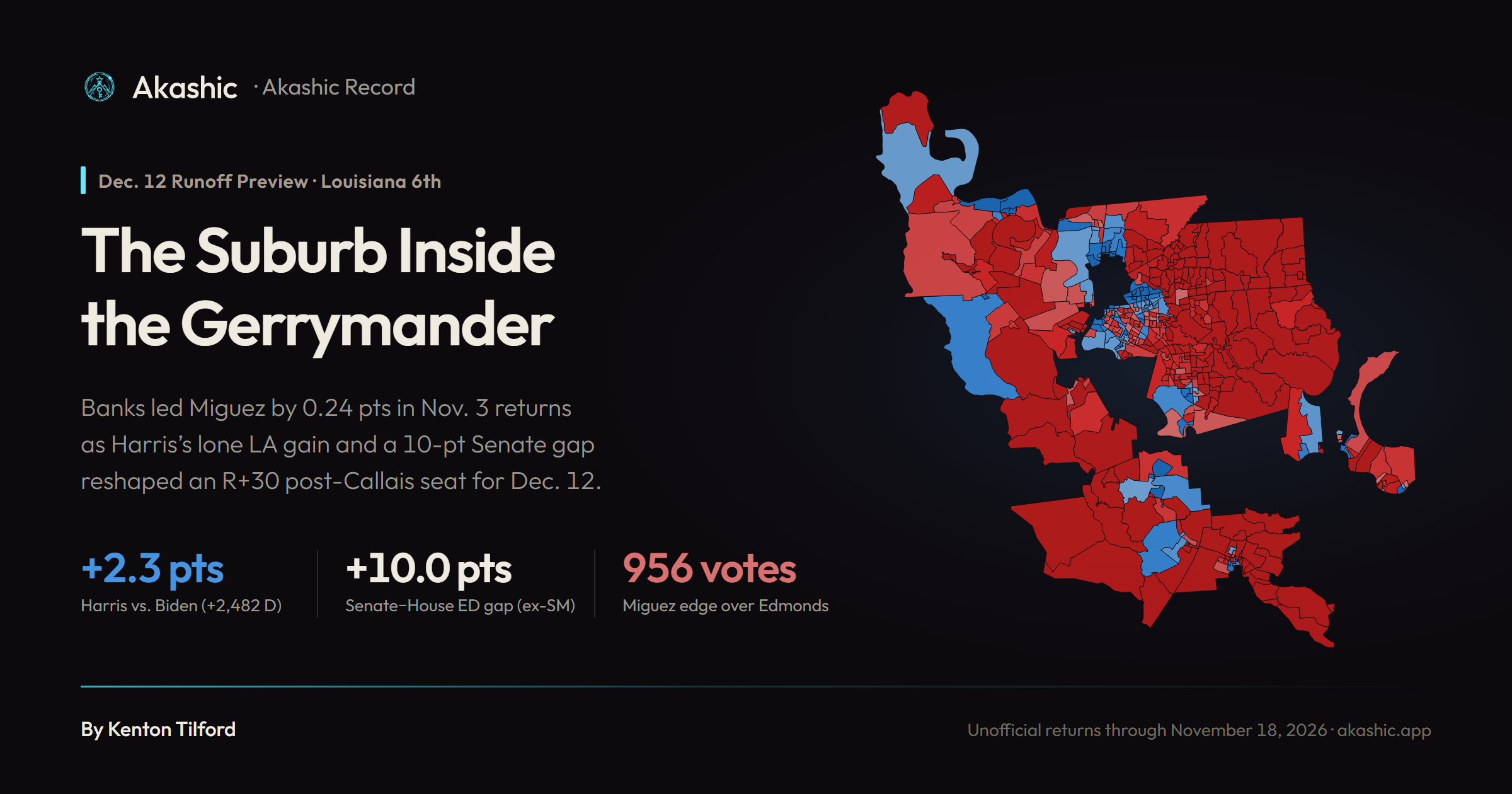
Nine hundred and fifty-six votes out of 262,712 separated Baton Rouge’s favorite-son Republican from a congressional runoff. Across eleven south Louisiana parishes on November 3, 2026, East Baton Rouge Metro Councilwoman Chauna Banks (DEM) led a chaotic ten-candidate jungle primary in Louisiana’s redrawn 6th Congressional District with 51,004 votes (19.41%), edging former Acadiana state senator Blake Miguez (REP) at 50,376 (19.18%) by 628 votes (0.24 percentage points)—while former Baton Rouge state representative Rick Edmonds (REP), sitting on nearly double Miguez’s home-parish vote share, finished third with 49,420 (18.81%) in unofficial Secretary of State returns updated through November 18.
Now Banks and Miguez face each other alone on Saturday, December 12 (with in-person and early voting running November 28 through December 5, excluding Sunday, November 29). At first glance, conventional handicapping makes the runoff open and shut: six Republicans and a Libertarian combined for 58.70% of the November 3 House vote (R+16.07 on party sums across all valid ballots), inside a district Donald Trump carried by roughly 30 points two years earlier after the Supreme Court’s Louisiana v. Callais ruling cleared the way for the Legislature’s new map (LA-ACT2-2026 / SB 121).
Yet the returns underneath November 3 tell a stranger, sharper story—one hiding in two facts most national coverage misses:
LA-06 is the only congressional district in Louisiana where Kamala Harris improved on Joe Biden—gaining both margin (+2.28 points) and raw Democratic ballots (+2,482) between 2020 and 2024 even as statewide Louisiana lurched 3.40 points right and lost 89,164 Democratic votes. In rebuilding LA-06 as a safe Republican bastion by carving Black North Baton Rouge out into LA-02, mapmakers anchored the new district on the single fastest leftward-moving suburban growth corridor in the state.
Inside the exact same electorate on November 3, 2026, Democrat Jamie Davis ran nearly ten points ahead of the combined three-Democrat House slate in the U.S. Senate race against Congresswoman Julia Letlow (R+12.37 vs. R+22.64 across all 541 matched Election Day precincts; ~R+6.6 estimated across all modes versus R+16.07 for the House party sum). And that ~10-point Senate-over-House gap did not come from rural crossover alone: it held uniformly at +9.3 to +10.4 points from Baton Rouge’s heaviest Democratic wards to Livingston Parish’s deepest Republican precincts.
Working hypothesis. Miguez still starts the December 12 runoff with the stronger structural math—backed by a +42,224-vote Republican Round-1 cushion, a roughly 6-to-8-point Senate-level Republican baseline, continuous GOP representation in pre-2024 Baton Rouge-based LA-06 elections since 1976, and a pre-realignment history of steeper Democratic drop-off in December runoffs. Yet the strongest case for Chauna Banks rests on an inverted turnout hypothesis: that post-realignment Democrats now command the more conscientious, habitual off-cycle coalition—and could turn out at an even higher relative rate on December 12 than on November 3, even though standalone December runoffs remain genuinely hard to predict. Testing that thesis against November’s returns shows why both the early-vote advantage (Banks led all candidates at 22.15%, pulling early ballots to R+4.84) and East Baton Rouge’s 46.17% weight give Banks a credible path if Miguez fails to re-activate Rick Edmonds’s 49,420 displaced voters and rural Trump +50+ parishes.
The only district in Louisiana moving left
To understand why LA-06 behaved differently on November 3, start two Novembers earlier. Across the entire country in 2024, Trump improved his national margin while running up numbers across the Deep South; statewide Louisiana shifted 3.40 points Republican (computed result from certified totals), widening from R+18.61 in 2020 (856,034 Biden to 1,255,776 Trump across 2,148,062 valid votes) to R+22.01 in 2024 (766,870 Harris to 1,208,505 Trump across 2,006,975 votes). Trump gained margin in five of Louisiana’s six congressional districts rebuilt under SB 121 (reaggregated / estimated from Census block allocations in Akashic district series, corroborated within 0.29 points by The Downballot 2024 baselines). In heavily Black LA-02 (New Orleans through North Baton Rouge), raw Democratic presidential ballots plunged by 44,531 and Harris trailed Biden by 4.86 points (D+52.26 to D+47.40). In LA-03, LA-04, and LA-05, margins fell 3.81 to 5.02 points right while Democratic totals dropped 10,888 to 17,393 votes. Even in Northshore-anchored LA-01, where margins nudged +0.80 points toward Democrats only because GOP turnout fell faster, Harris still trailed Biden’s raw count by 2,849 votes.
LA-06 stood completely alone. Under LA-ACT2-2026 lines, Harris polled 123,336 votes to Trump’s 230,738 across 360,401 total valid ballots (R+29.80; The Downballot independently puts the 2026 lines at 122,761 to 231,162 / 360,237 = R+30.09). Compared to Biden’s 120,854 to 238,231 / 365,903 (R+32.08) in 2020, Harris beat Biden in LA-06 by +2.28 points and +2,482 raw Democratic votes while Trump lost 7,493 votes. Stretch the lens back twenty years on the same lines, and LA-06 has drifted leftward in every single presidential cycle since 2008: from R+34.81 (2004) and R+36.66 (2008) to R+36.15 (2012), R+33.54 (2016), R+32.08 (2020), and R+29.80 (2024)—a +6.86-point cumulative move toward Democrats over sixteen years in a state that drifted 3.38 points right over the exact same span.
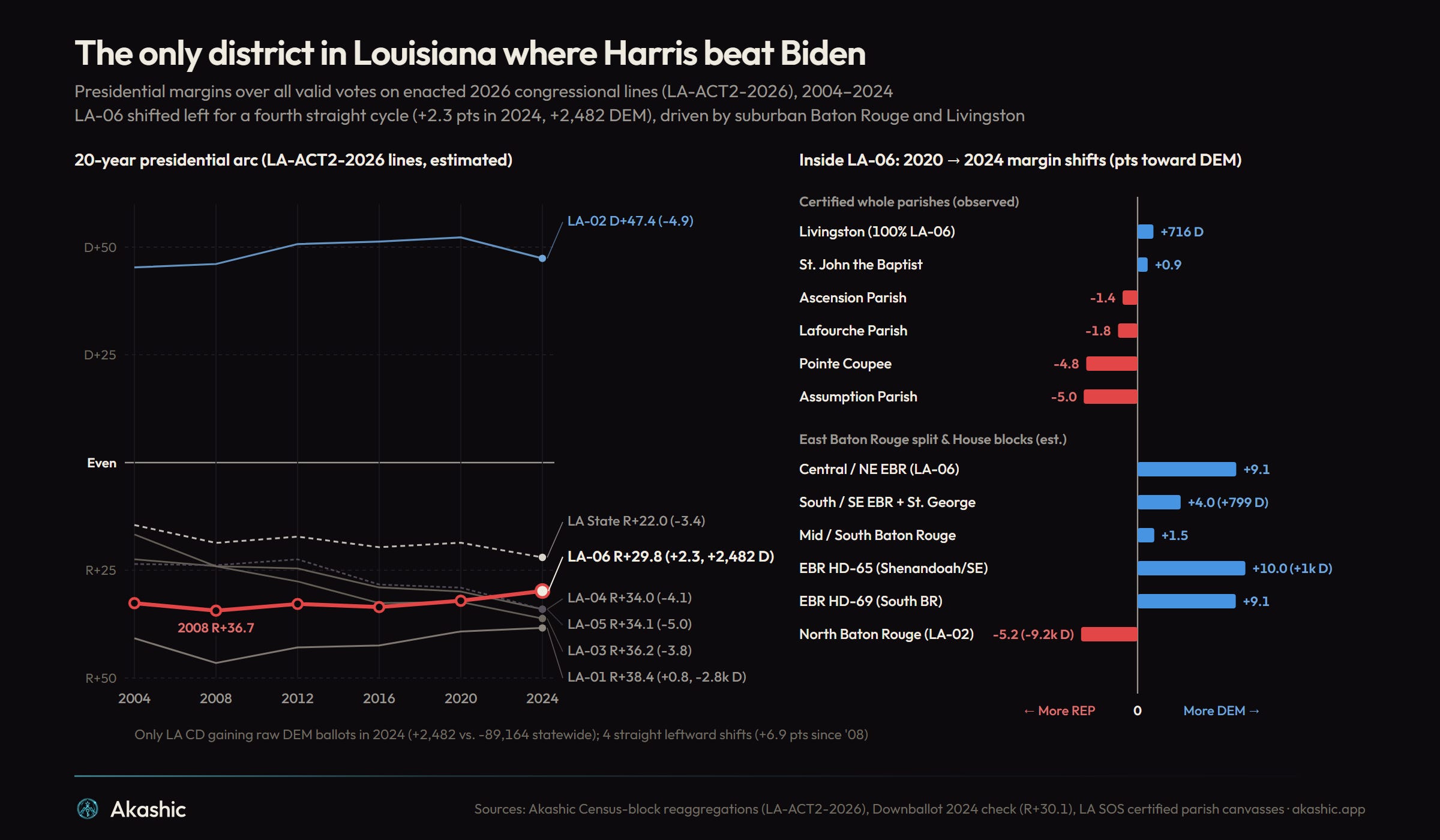
Where did Harris’s gains come from inside the eleven parishes of LA-06? Looking solely at whole certified parish totals obscures the mechanism, because whole East Baton Rouge Parish fell 1.98 points right (D+13.04 to D+11.07, down 11,757 Democratic votes). Unpacking Baton Rouge into its two redrawn congressional halves resolves the paradox cleanly across three independent layers of evidence:
Observed whole-parish proof in exurban Livingston (verified fact / computed result). Directly east of Baton Rouge, fast-growing Livingston Parish—100% contained inside LA-06—shifted +1.46 points Democratic (R+69.95 to R+68.49) and added +716 raw Democratic votes (9,249 to 9,965, a +7.7% expansion) while Trump gained just 224 votes (54,877 to 55,101). Across the district’s river and bayou parishes, certified St. John the Baptist nudged +0.94 points left (D+28.20 to D+29.14), while rural Cajun and Mississippi River parishes moved right (Assumption -4.99, Pointe Coupee -4.75, St. Martin -4.61, Iberville -4.45, St. Charles -2.77, Lafourche -1.81, Ascension -1.39, West Baton Rouge -1.17).
The East Baton Rouge internal fracture (reaggregated precinct boxes and estimated State House blocks). Whole-parish EBR dropped in 2024 entirely because majority-Black North Baton Rouge—carved out of LA-06 into LA-02—suffered severe presidential turnout drop-off (LA.json spatial box: D+84.51 to D+79.27, -5.24 points and -9,158 Democratic votes; State House HD-61 -5,206 DEM votes and HD-67 -3,168 DEM votes). Conversely, the suburban half of East Baton Rouge placed inside LA-06 moved steadily left in both margin and Democratic turnout: Central / Northeast EBR flipped from R+7.26 to D+1.88 (+9.13 points), South / Southeast EBR including newly incorporated St. George moved +3.99 points left (R+29.65 to R+25.66, +799 Harris votes vs. -1,141 Trump votes), and Mid / South Baton Rouge moved +1.54 points. Block-aggregated State House districts spanning the LA-06 corridors of Baton Rouge posted even sharper shifts from 2020 to 2024: HD-65 (+9.98 points, +1,001 DEM / -1,262 REP), HD-69 (+9.08 points, -1,687 REP), HD-70 (+8.84 points, +1,140 DEM), HD-66 (+8.74 points, +1,992 DEM), and HD-68 (+6.98 points, +1,141 DEM).
Here sits the structural irony of Louisiana’s 2026 map. When legislators dismantled Rep. Cleo Fields’s temporary 2024 minority-opportunity district after Callais, they packed North Baton Rouge’s low-turnout Democratic base into LA-02 and tucked Baton Rouge’s college-educated, white-collar, and diversifying south and eastern suburbs into a nominally R+30 LA-06 alongside Livingston, Ascension, and Lafourche. On paper, it restored the classic Baton Rouge-plus-Florida-Parishes Republican fortress. In practice, it hitched that fortress to the only suburban belt in Louisiana trending steadily toward Democrats.
The ten-point phantom: U.S. Senate vs. U.S. House inside LA-06
If the 2024 presidential baseline planted a quiet time bomb beneath LA-06, the 2026 U.S. Senate ballot detonated half of it on the same day. Statewide on November 3, Republican Congresswoman Julia Letlow edged Democratic farmer Jamie Davis by 1.76 points (745,961 to 720,111 across 1,466,072 valid votes in the 2026-11-07 seed). Inside the exact geography of LA-06, however, comparing the two-way Senate contest directly against the ten-candidate U.S. House contest reveals a 10-point chasm between how voters behaved on a clean two-party line and how they voted in a fractured ten-way open primary.
Start with the observed totals across all 262,712 live unofficial House ballots (2026-11-18 SOS update; the frozen 2026-11-13 SQLite seed carries 261,963, before Ascension Parish added 749 votes in precincts 00/08 A and 00/11 A). Summing by party, the three Democrats—Banks (51,004), Lindsay "Rubia" Garcia (33,632), and Patrick "Pat" Forbes (23,869)—won 108,505 votes (41.30%). The six Republicans—Miguez (50,376), Edmonds (49,420), Pointe Coupee businessman Stephen Wagley (28,239), Livingston councilman Larry Davis III (11,388), Black conservative activist Monique Appeaning (8,139), and Michael Mebruer (3,167)—combined for 150,729 votes (57.37%), alongside Libertarian perennial Rufus Craig (3,478, 1.32%). Party-wide, that is an R+16.07 House margin.
Yet on the exact same November 3 ballots inside LA-06, Jamie Davis ran 8 to 10 points ahead of the three-Democrat House sum across every verifiable test:
All 541 matched Election Day precincts (100% of LA-06 Election Day ballots, observed). Matching every single Election Day precinct in ByPrecinct_70200.csv directly to its identical row in the statewide Senate CSV (ByPrecinct_67997.csv) gives R+22.64 in the House party sum (62,820 DEM vs. 100,348 REP across 165,774 valid votes) against R+12.37 in the U.S. Senate (73,562 Davis vs. 94,338 Letlow across 167,900 valid votes)—a +10.26-point Senate-over-House Democratic overperformance. Excluding two Lower St. Martin precincts (00/01 and 00/02, 261 Senate votes representing 0.15% of the district Election Day total) where unofficial SOS files show an anomalous 232 Davis to 29 Letlow split despite 84.0% GOP House voting, the remaining 539 clean precincts still show +10.03 points (R+22.54 House vs. R+12.51 Senate, 16.75 points bluer than 2024 Trump Election Day R+29.26).
Three whole observed parishes (all-mode observed, zero estimation). Because Livingston, Pointe Coupee, and Assumption lie 100% inside LA-06, their Parishwide + Early + Election Day Senate returns map directly to the district without allocation models. Every single one delivered double-digit Senate-over-House Democratic overperformance: Livingston moved from R+55.34 (House) to R+45.08 (Senate, +10.26 points, 23.41 points left of Trump); Pointe Coupee jumped from R+22.78 to R+6.19 (+16.58 points); and Assumption tightened from R+24.89 to R+11.49 (+13.39 points).
Uniformity across every partisan tier. Splitting the 540 2024-matched Election Day precincts into five bands by 2024 presidential lean disproves the lazy assumption that Jamie Davis only outran Banks–Garcia–Forbes among ancestral rural whites. The Senate minus House Democratic gap was almost flat everywhere: +9.82 points in Harris +30+ precincts (n=84), +9.29 points in Harris 0 to +30 (n=68), +10.05 points in Trump 0 to +25 battleground suburbs (n=83, where Davis virtually tied Letlow at R+0.58 [49.71% to 50.29%] while House Democrats trailed by 10.63 points), +10.03 points in Trump +25 to +50 (n=110), and +10.43 points in Trump +50+ (n=195; +9.80 points without St. Martin 00/01–02). In a crowded ten-way jungle primary with local mayors, parish councilmen, a Black conservative candidate, and a Libertarian, roughly five percent of Davis’s coalition voted for a local Republican or Craig on the House line—a pool no longer available to Miguez in a strict one-on-one race.
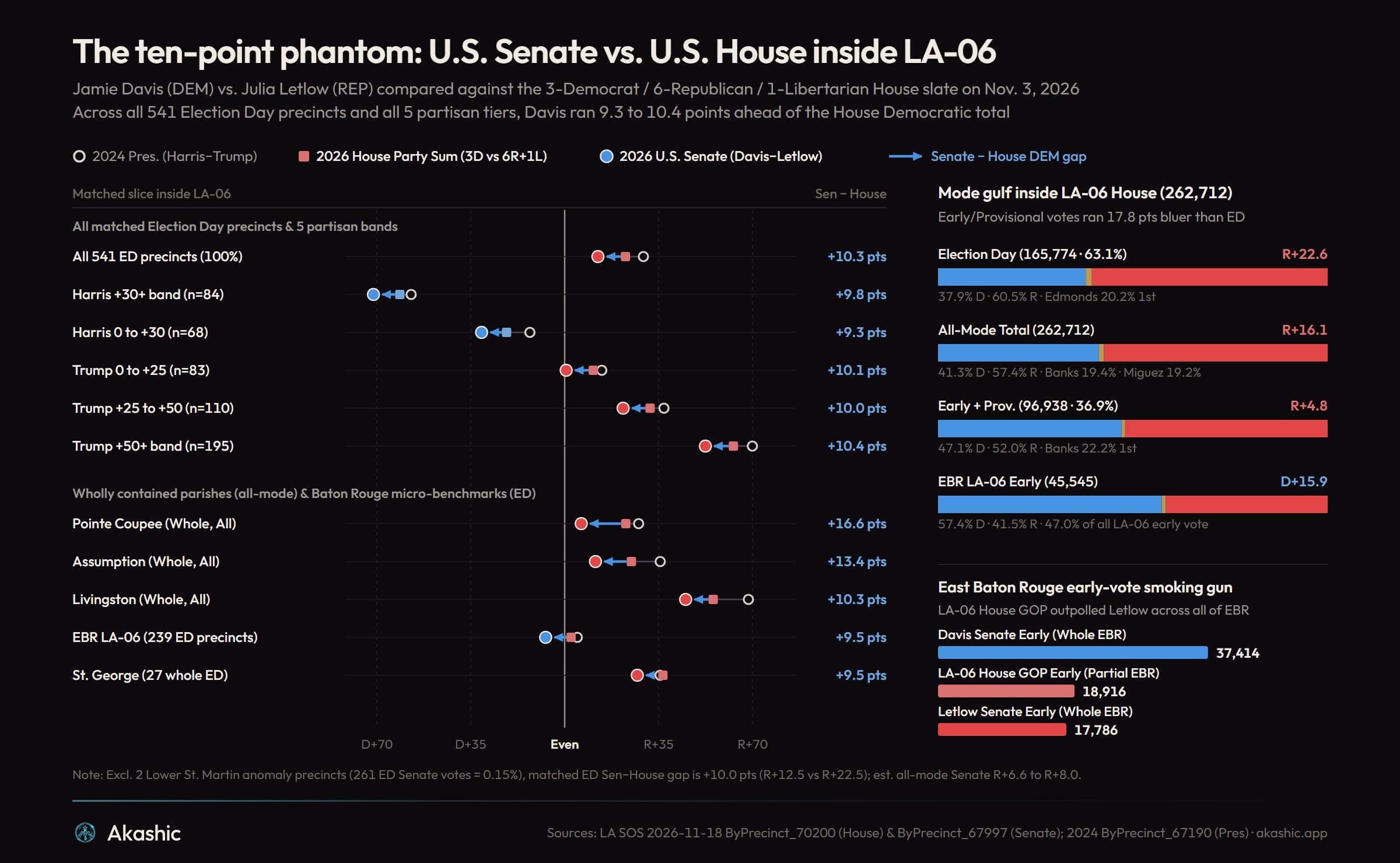
Look equally closely at East Baton Rouge Parish and early voting, where Louisiana’s Secretary of State reports LA-06 House early ballots separately from parishwide Senate early ballots. Across the whole district, 96,938 votes (36.90% of all LA-06 ballots) were cast early or provisionally, and they broke 17.80 points bluer than Election Day: R+4.84 (47.13% DEM, 51.97% REP, 0.90% LIB) versus R+22.64 on Election Day. Banks actually finished first in districtwide early voting with 22.15% (21,468 votes to Miguez’s 18,120 [18.69%] and Edmonds’s 16,003 [16.51%]), even though Edmonds led Election Day (20.16%) ahead of Miguez (19.46%) and Banks (17.82%).
Inside East Baton Rouge LA-06, early ballots (45,545 votes) broke D+15.90 (26,158 DEM to 18,916 REP), flipping EBR’s all-mode House tally from R+2.39 on Election Day to D+4.48 overall. Even better, EBR early ballots contain an undeniable arithmetic smoking gun for the Senate race: House Republicans inside LA-06 (18,916) received 1,130 more early votes than Julia Letlow (17,786) received across the entire parish of East Baton Rouge (even including EBR’s LA-02 precincts), while Davis swept 37,414 parishwide early votes (67.78%). Calibrating EBR LA-06’s Senate early vote to its observed 45,545 House early volume and LA-02’s exact 94.98% Democratic Election Day share puts EBR LA-06’s all-mode Senate result near D+13.6—and puts LA-06 all-mode Senate districtwide at roughly R+6.6 (ex-St. Martin, 46.7% Davis to 53.3% Letlow), or R+8.0 under a conservative ED-proportional bound that leaves ~3,300 EBR LA-06 early ballots on the table. Either way, two-way Senate baseline voting inside LA-06 sits 8 to 10 points closer than November’s R+16.1 House sum.
Five zones, St. George, and 100,353 orphaned votes
Zooming into the map’s geography explains why both Miguez and Banks face unusual coalition math on December 12. Unlike old pre-2024 LA-06, which functioned as a compact Baton Rouge suburban-plus-Livingston Republican stronghold, post-Callais LA-06 stitches together five distinct zones with sharply different primary loyalties and midterm retention rates:
East Baton Rouge (121,287 House votes — 46.17% of district; D+4.48 House, ~D+13.6 est. Senate). Nearly half the electorate lives here, yet Blake Miguez finished fourth (12.40%, 15,040 votes) behind Banks (24.81%, 30,091), Edmonds (19.71%, 23,910), and Garcia (15.49%, 18,787). Crucially, Baton Rouge turnout held up far better than the rural parishes: EBR LA-06 cast 102.0% as many Election Day House ballots (75,742) as its 2024 presidential Election Day total (74,236), and retained roughly 82.8% of estimated 2024 all-mode presidential volume.
St. George — the conservative anchor inside EBR (observed 27 wholly contained ED precincts). Inside East Baton Rouge’s newly incorporated southern city of St. George, November 3 Election Day turnout (14,914 House votes; 14,958 Senate votes) actually topped 2024 presidential Election Day (13,704) by +8.83%—driven by a home-turf battle where Rick Edmonds doubled Miguez (34.07% / 5,081 votes vs. 16.86% / 2,515). Even in conservative St. George (2024 Trump R+35.58), where all-candidate House voting stood at R+36.62, Jamie Davis pulled 36.46% (5,453 to Letlow’s 9,505, R+27.09)—a +9.53-point Senate-over-House boost identical to the rest of the district.
Livingston Parish (43,383 votes — 16.51%; R+55.34 House, R+45.08 Senate). Still deep red, yet only 65.8% of its 2024 presidential electorate turned out in November (43,383 of 65,906), and Miguez (25.53%) barely edged Edmonds (23.89%) while local parish councilman Larry Davis III pulled 13.48% (5,849 votes).
Ascension Parish (40,248 votes — 15.32%; R+22.11 House). Splitting down I-10 between Baton Rouge commuters and River Road towns, Ascension saw a tight three-way split (Miguez 21.28%, Edmonds 19.29%, Banks 17.95%) with 70.0% estimated presidential turnout retention.
River Parishes & Bayou / Acadiana (57,794 combined — 22.00%). Across the five River Parishes (St. Charles, St. John the Baptist, Iberville, West Baton Rouge, Pointe Coupee — 33,628 votes, 12.80%, R+15.89), Miguez (20.98%) and Banks (20.43%) ran virtually dead even while Stephen Wagley took 17.63% overall (and carried Pointe Coupee and West Baton Rouge) and St. Charles alone retained ~82.0% of 2024 turnout. Only down the bayou—in Lafourche, Assumption, and Miguez’s home-edge St. Martin sliver (24,166 votes — 9.20%, R+38.91)—did Miguez (35.76%) dominate the field, while Lafourche posted just 66.1% turnout retention.
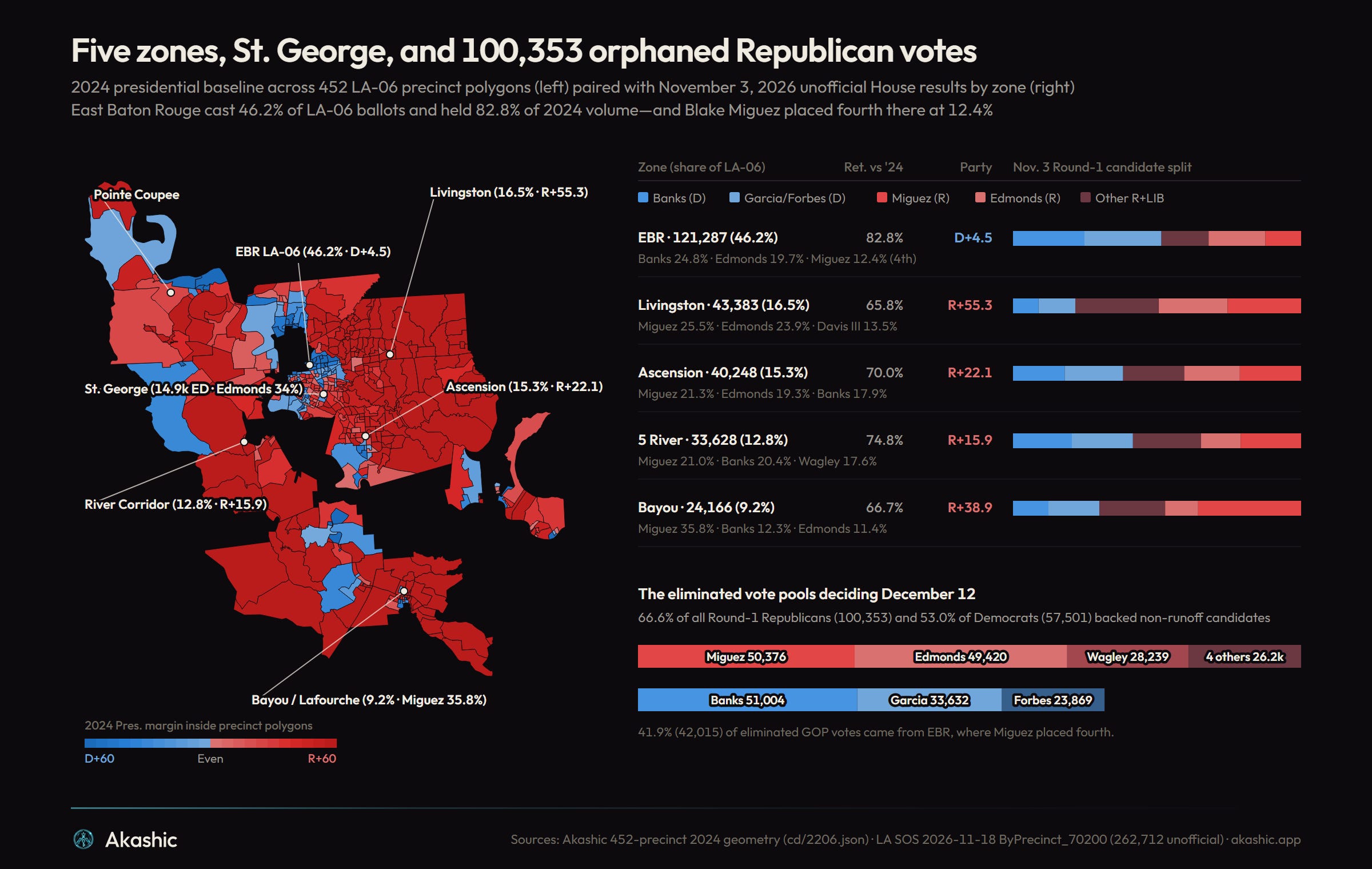
Look at what that map leaves on the table for December 12: 100,353 Republican votes (66.6% of all Round-1 GOP ballots!) went to five eliminated candidates—led by Edmonds (49,420) and Wagley (28,239)—while 57,501 Democratic votes (53.0% of Round-1 DEM ballots) went to Garcia (33,632) and Forbes (23,869). Miguez won Round-1 plurality strength in Bayou/Acadiana and narrow edges in Livingston, Ascension, and the River corridor, while 41.9% (42,015 of 100,353) of his Round-1 rival Republicans’ votes sat inside East Baton Rouge Parish, where Miguez finished fourth.
The December 12 arithmetic
How do those structural tensions collide over three weeks from Thanksgiving through Saturday, December 12? An honest preview starts with why Blake Miguez holds the stronger baseline—and why pre-realignment December history points his way:
The structural Republican baseline remains formidable (verified fact & computed result). Every plausible estimate of a head-to-head race between Miguez and Banks begins well inside Republican territory—from R+6.6 (Senate calibrated baseline, 46.7% D / 53.3% R) to R+16.1 (Round-1 House party total). Even in a strong Democratic environment like November 3, statewide U.S. Senate turnout only got a Democrat within 6.6 to 8.0 points inside LA-06, and Miguez holds +42,224 total Republican Round-1 ballots to draw from.
Pre-realignment Louisiana December runoffs heavily favored Republicans (historical benchmark). The nearest precedent inside LA-06 is 2014: on November 4, 2014, former Governor Edwin Edwards (DEM) actually led the jungle primary at 30.12% (77,866 votes across ~258,487 total, while Rufus Craig [LIB] took 3,561 / 1.38%—nearly identical to Craig’s 3,478 / 1.32% in 2026!) ahead of Republican Garret Graves (27.36%, 70,715) because six Republicans split 62%+ of the primary vote. One month later on December 6, 2014, total turnout dipped -13.7% to 222,990, Edwards edged up only modestly (83,781, 37.57%), and Graves consolidated the GOP field to win 62.43% (139,209). Across standalone December U.S. Senate runoffs with no top-of-the-ticket anchor, participation falls even faster—statewide turnout slipped from 51.5% to 43.6% in December 2014, and collapsed from 67.8% to ~29.2% in December 2016 (Kennedy 60.65% – Campbell 39.35%).
Two-way sorting cuts both ways. Just as Senate voters moved toward Jamie Davis once local GOP House candidates dropped off, a non-trivial share of 57,501 Garcia and Forbes voters—particularly rural River/Bayou cross-over voters or conservative Democrats—may simply abstain or split in December, while Wagley’s rural Pointe Coupee/West Baton Rouge voters lean predominantly Republican.
Yet applying 2014–2016 turnout assumptions mechanically misses what shifted over the past decade (author judgment & hypothesis): in 2014 and 2016, Republicans still held the higher-propensity, college-educated off-cycle coalition, so a steeper December drop-off widened GOP margins almost automatically. Today’s Democratic coalition skews more habitual and attentive in off-cycle elections—raising the central empirical argument for Banks: that LA-06 Democrats and Democratic-leaning suburbs could show up on December 12 at an even higher relative rate than they managed on November 3, though low-information December runoffs remain notoriously hard to model.
Testing that conscientious-coalition hypothesis directly against November 3’s precinct-level turnout retention inside LA-06 (computed result, n = 540 2024-matched Election Day precincts) surfaces both strong supporting evidence and one crucial warning sign:
What backs the conscientious-coalition case: Deep-red Trump +50+ precincts (n = 195) suffered the lowest Election Day retention in the district relative to 2024 presidential ballots (89.27% in the House race; 90.24% in Senate), matching Livingston Parish’s 65.8% and Bayou/Acadiana’s 66.7% all-mode retention. By contrast, Harris 0 to +30 precincts held 98.18% Election Day retention (99.15% Senate), Trump 0 to +25 educated suburbs—where Jamie Davis virtually tied Letlow (R+0.58)—surged to 100.72% (101.94% Senate), Harris +30+ precincts (91.53% House / 94.23% Senate) still out-retained Trump +50+ even before counting early voting, EBR LA-06 as a whole retained 82.8% all-mode (102.0% Election Day), and early voters broke 17.80 points bluer than Election Day (R+4.84 overall, D+15.90 inside EBR). If that same propensity gradient widens in a smaller December electorate, it simultaneously boosts EBR’s share of total turnout and improves Democratic two-way vote share inside every parish.
What complicates it—and why December 12 stays hard to call: High-propensity off-cycle turnout inside LA-06 is not exclusively Democratic. Inside East Baton Rouge Parish itself (n = 238 matched Election Day precincts), affluent conservative neighborhoods (Trump +25+, n = 79) actually posted the highest Election Day retention of all at 104.36% (104.55% Senate, anchored by St. George’s 27 wholly contained precincts at 108.83%), right alongside Trump 0 to +25 (103.27%) and Harris 0 to +30 (99.83%), outpacing Harris +30+ (95.57%). Whether Democratic conscientiousness—amplified by rural Trump +50+ drop-off and a 17.8-point early-voting gap—wins December 12 depends heavily on whether St. George and Ascension’s high-propensity suburban Republicans show back up for Acadiana’s Miguez once hometown favorite Edmonds is off the ballot. With no modern post-realignment congressional runoff to calibrate on this map, turnout composition remains genuinely unpredictable until early voting opens.
Now place that turnout test on our 6 × 6 two-way sensitivity matrix (model output combining November’s EBR vs. rest-of-district baselines across East Baton Rouge share of the Dec. 12 electorate [43% to 58%] and two-way Democratic consolidation from Nov. House [41.9%] through Senate Baseline [46.7%] up to Senate +6.0 pp):
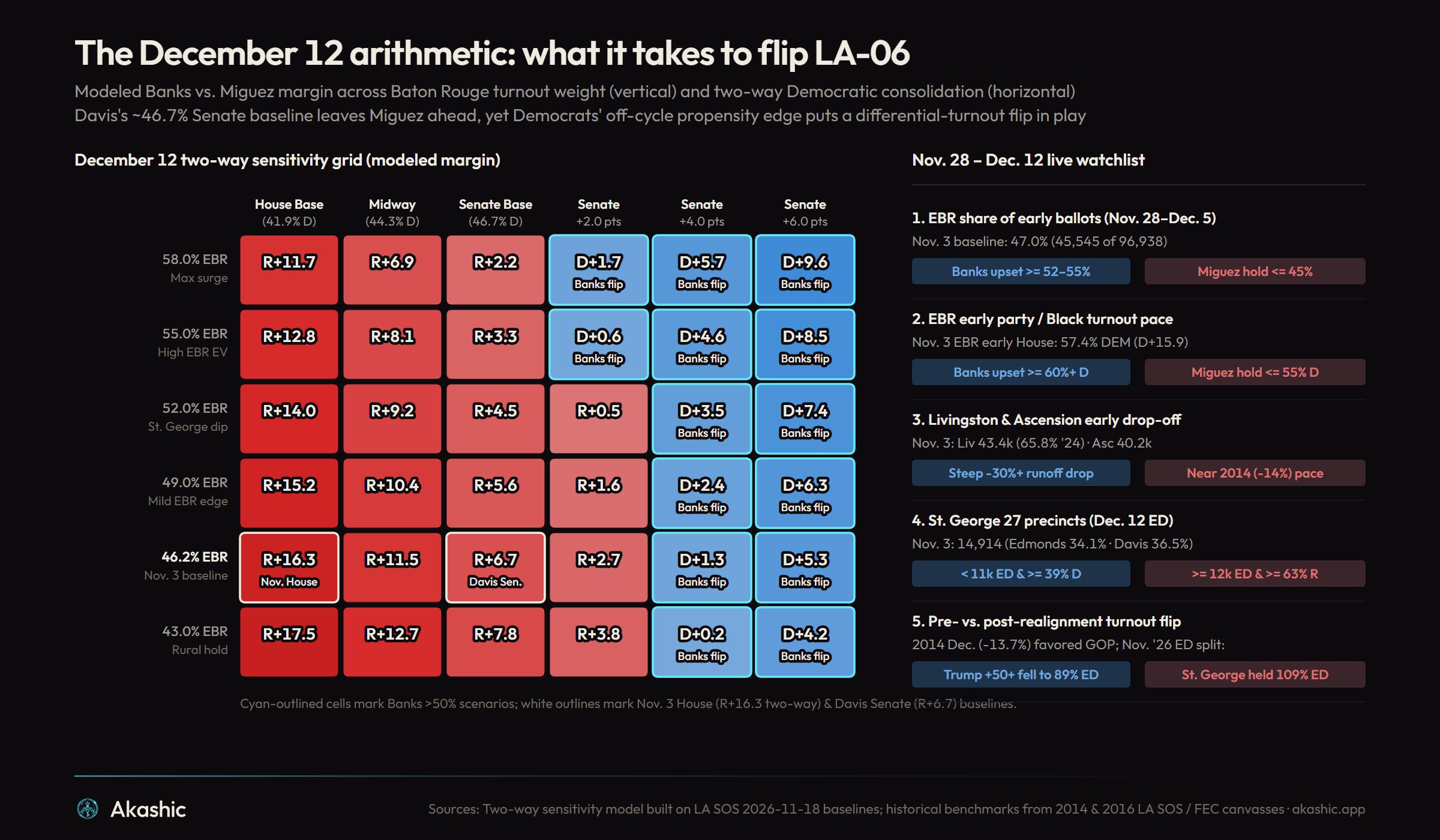
Look at what the grid shows—and why a conscientious-coalition surge changes where you land on it:
At November’s turnout weights, matching Jamie Davis’s coalition alone is not enough (model output). Even if Banks wins the exact two-way Senate coalition in both Baton Rouge (56.8% D) and the outer ten parishes (38.0% D), and even if EBR swells from 46.2% to 55.0% of the December electorate, Miguez still holds R+3.33. Because EBR starts at 46.2% of LA-06, geographic weight alone adds only ~0.38 points of district margin for every +1.0 point gain in EBR’s share of total votes.
To cross 50.0%, Banks needs both Baton Rouge composition (52%–55%+ EBR share) and another +2 to +4 points of net two-way swing beyond Davis’s Senate baseline. Under a conscientious-coalition turnout edge, those two levers move together rather than independently: if habitual Democratic voters turn out at higher relative rates in December than on November 3 while Rick Edmonds’s 49,420 Baton Rouge and St. George Republicans and Trump +50+ rural voters abstain more heavily with Acadiana’s Miguez atop the ticket, EBR expands toward 52%–55%+ and local two-way margins shift leftward inside both EBR and the outer ten parishes. Conversely, if St. George’s 108.8% high-propensity conservative core and Ascension suburbs return in full alongside rural parishes near 2014 levels, Miguez wins by 6 to 13 points.
What separates those two outcomes will show up publicly before December 12 polls open, during the November 28–December 5 early-voting window. Readers tracking Secretary of State daily early-vote reports only need four concrete benchmarks:
EBR’s share of early ballots: In November, East Baton Rouge cast 46.98% (45,545 of 96,938) of all LA-06 early/provisional votes. If EBR exceeds 52%–55%+ of early ballots by December 5, Banks is reshaping the runoff electorate; if EBR drops near 43%–45%, the rural/suburban GOP floor is holding.
EBR party / racial early composition: Democrats held 57.4% of all November early House votes inside EBR (26,158 of 45,545, D+15.90); retaining >=60% Democratic or high Black turnout share is mandatory to expand beyond Davis’s ~57% EBR baseline.
Livingston & Ascension early turnout vs. Nov. 3 (15,095 Livingston / 16,169 Ascension early in Nov.): Watching whether Livingston and Ascension drop -30% to -40% (as in Nov. vs. 2024) or hold steady around 2014’s -14% runoff decline decides Miguez’s suburban cushion.
St. George Precinct Group Election Night: Look at the 27 wholly contained St. George precincts (14,914 House ED on Nov. 3) on December 12 night. If St. George’s Election Day turnout drops steeply below ~10,000–11,000 (meaning Edmonds’s 5,081 St. George voters stayed home) and Banks clears ~38%–40%+ there (above Davis’s 36.46%), the upset path is live; if St. George turns out strong and votes 63%+ Miguez (matching Letlow’s 63.54%), Miguez carries the Sixth smoothly.
Method, briefly. All candidate vote shares and margins are computed over total valid candidate ballots recorded for each race, preserving minor-party and third-party candidates alongside Democratic and Republican nominees. November 3, 2026 LA-06 congressional counts use the first_round ballot stage and reflect unofficial Louisiana Secretary of State returns through November 18, 2026 (262,712 votes across eleven parishes, reflecting +749 votes in two Ascension Parish precincts over the frozen November 13 snapshot of 261,963). U.S. Senate comparisons (Jamie Davis vs. Julia Letlow) use exact precinct-by-precinct Election Day matches across all 541 LA-06 precincts (with the 261-vote Lower St. Martin anomaly flagged separately), observed all-mode returns in three wholly contained parishes, observed 27-precinct St. George returns, and an EBR-volume-calibrated all-mode district estimate (R+6.6 ex-St. Martin). Historical 2004–2024 congressional district baselines use Akashic Census-block reaggregations on enacted LA-ACT2-2026 boundaries paired with The Downballot 2024 baselines and certified parish canvasses.
Continue the conversation on Substack
Leave a comment, like, or restack this dispatch to help more readers find Akashic.