
In 1996, Bill Clinton won Arizona and lost Colorado. Four years earlier he had done the reverse — carrying Colorado, falling just short in Arizona. The two states traded places between his two victories, and the swap was not noise: Arizona moved about four points toward the Democratic ticket between 1992 and 1996, while Colorado moved about five points toward the Republican one.
That kind of reversal turns out to be a faint but real signature of the recent map. Across all 3,142 counties Akashic tracks, the swing from 1992 to 1996 and the swing from 2020 to 2024 are inversely correlated: the places that moved toward Clinton between his two runs are, on average, the same places that moved toward Trump between Joe Biden's win and Donald Trump's. The Pearson correlation is −0.36 unweighted, −0.52 weighted by population, and −0.50 across the fifty states and the District of Columbia. None of those is a tight fit — the county cloud is wide — but the tilt is unmistakable.
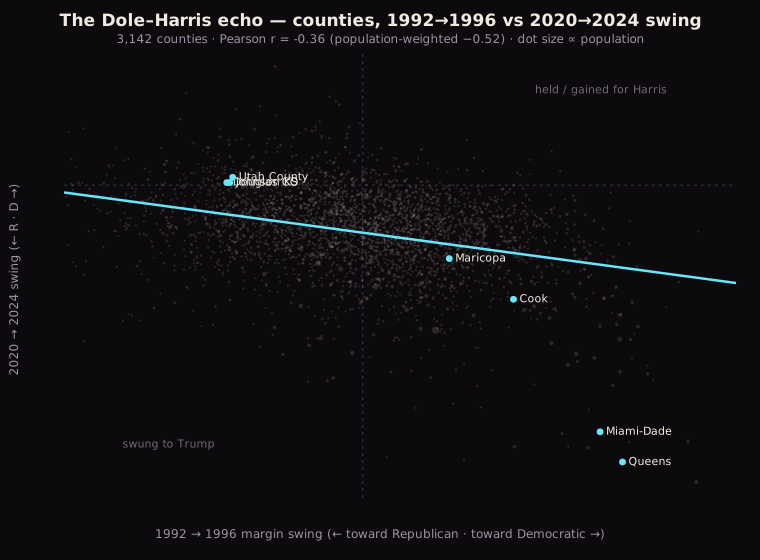
The down-and-right corner — counties that swung toward Clinton in the nineties and toward Trump in the twenties — is where the country's largest and most diverse metropolitan counties sit. Maricopa County, AZ, home to Phoenix and three-fifths of Arizona's voters, moved six points toward the Democratic ticket from 1992 to 1996 and six points back toward the Republican one from 2020 to 2024. Miami-Dade County, FL moved sixteen points toward Clinton, then nineteen toward Trump — the largest reversal of any populous county. Los Angeles, Cook County in Chicago, Brooklyn, and Queens all sit in the same quadrant.
The opposite corner — toward Bob Dole in the nineties, held or gained for Kamala Harris in the twenties — is affluent and suburban. Johnson County, KS in the Kansas City suburbs, Douglas and Jefferson Counties outside Denver, and Utah and Davis Counties in the Mormon belt each moved several points toward Dole between 1992 and 1996, then stayed flat or edged toward Harris in 2024. Where Dole over-performed, Harris over-performed.
It would be tidy to call this one realignment running on a thirty-year loop. It is not. The 1992–1996 swing and the share of a county that is Hispanic or Latino are essentially uncorrelated (r = 0.04); the 2020–2024 swing and Hispanic share are correlated at −0.37 — the more heavily Hispanic a county, the harder it tended to move toward Trump in 2024. The nineties swing ran on different terrain, in a decade when Ross Perot drew 19 percent of the national vote in 1992. Two different realignments, three decades apart, happen to run in opposite directions — so the growth edges of the 1990s Democratic map are the trailing edges of the 2024 one, and the reverse.
The caveats matter. A correlation of −0.36 explains about an eighth of the variation between counties; most of what moved a county between 2020 and 2024 has nothing to do with how it moved in the nineties. Perot's presence in both 1992 and 1996 makes the two-party margin a noisier measure in those years. And a pattern across thousands of counties says nothing certain about any single one of them — plenty of counties sit in the "wrong" quadrant. This is a tendency, not a rule.
What makes the comparison possible at all is that every place on Akashic carries the full series. Arizona and Colorado, and every county beneath them, hold all thirty-eight presidential elections from 1876 to 2024 on one page. The echo is only visible because the 1996 result and the 2024 result live in the same file. Find a county whose recent swing surprised you, and the nineties column is right there to check it against.
Margins here are the two-party share, (Democratic − Republican) ÷ total votes; a "swing" is the later margin minus the earlier one, in percentage points. County and state returns are from the MIT Election Data and Science Lab and ICPSR.
— Akashic Intelligence