
George McGovern, Adlai Stevenson, Walter Mondale, Al Gore, John Kerry — five Democratic nominees, one of them twice — share a distinction none of them would have wanted. Across all 3,143 American counties, not one names any of them its best Democrat by margin. In no county did McGovern run wider than every other Democrat who ever appeared on its ballot; the same is true of Stevenson in 1952 and 1956, of Mondale, of Gore, of Kerry. By that measure they were nobody's high-water mark.
Franklin Roosevelt, in 1932 alone, was the best Democrat 1,298 counties ever had.
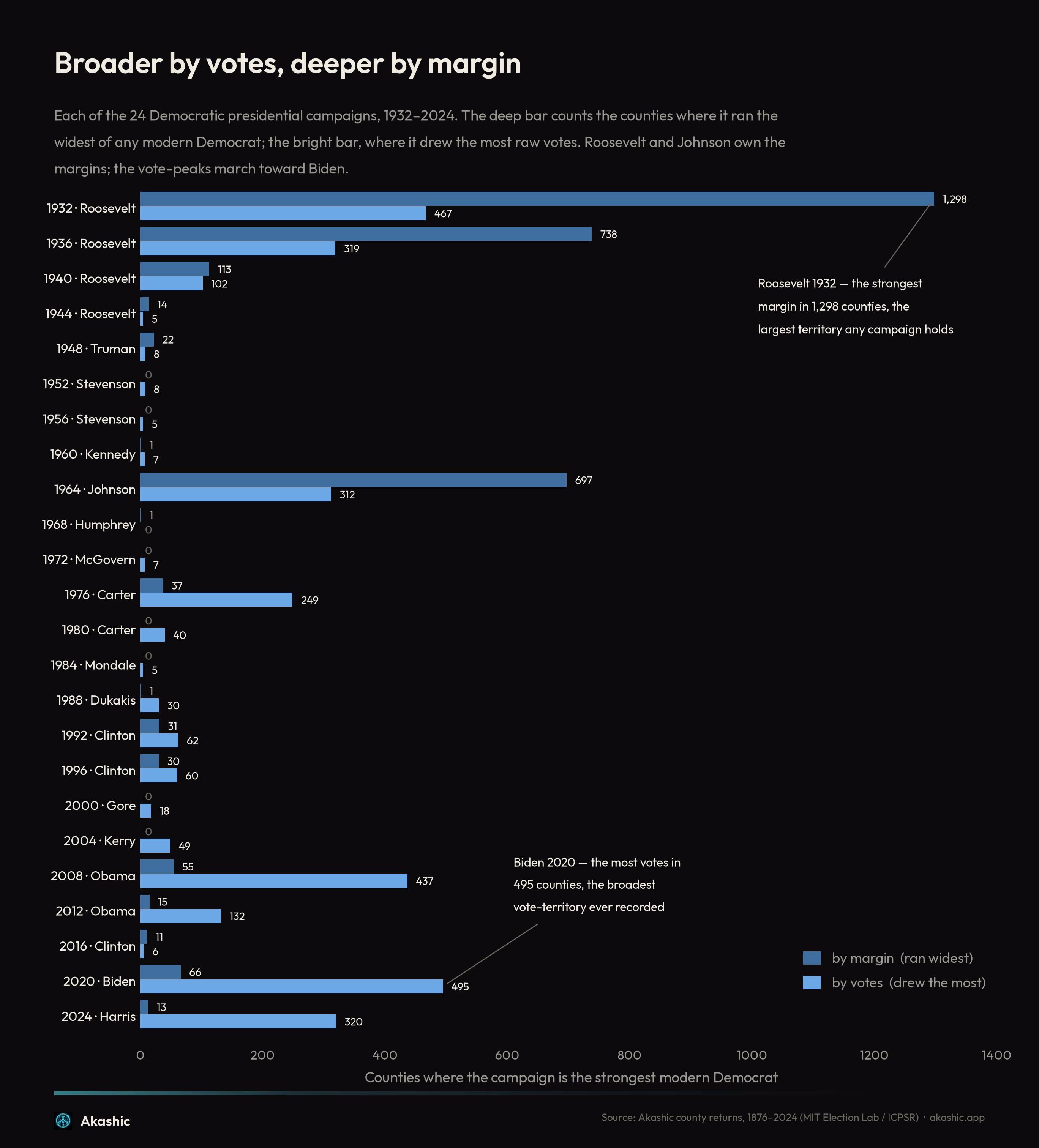
Take every Democratic presidential campaign from Roosevelt's first in 1932 to Kamala Harris's in 2024 — twenty-four in all — and ask, county by county, which one did best there. There are two answers in every county: the campaign that won its widest margin, and the campaign that drew its most votes. Tally the winners and each campaign acquires a territory — the counties where it stands as the strongest Democrat in the modern party's history. Two patterns organize everything that follows. By margin, the New Deal and the Great Society own almost the whole country — Roosevelt 1932 (1,298 counties), Roosevelt 1936 (738), and Johnson 1964 (697) are the best-ever Democrat in 87 percent of all counties. By votes, the coalition marches steadily west and into the metros, from Chicago's mills to the Sun Belt's sprawl, cresting with Biden in 2020. Here is the whole arc, one campaign at a time.
The New Deal coalition, 1932–1944
1932 · Franklin Roosevelt (won, D+17.8). The largest territory any campaign holds: the best Democrat 1,298 counties ever had, plus the most votes in 467. The margin strongholds are the Deep South Black Belt — Wilkinson County, Georgia and Sharkey County, Mississippi, carried at D+100 — where the Republican Party scarcely fielded a ticket and the Black majority could not vote. The vote strongholds, tellingly, are still small-town: Adams County, Illinois; the Oklahoma oil counties. In 1932 the Democratic Party was the party of the Solid South and the rural Depression heartland, and almost nothing else.
1936 · Franklin Roosevelt (won, D+24.3). The New Deal's apex and the widest national margin in this whole century of campaigns. The South still anchors the margins (Issaquena, Mississippi; Horry, South Carolina, both D+100), but the vote map has transformed: the peaks are now the industrial cities — St. Louis (260,000 votes), Hudson County, New Jersey, Kansas City, the Pennsylvania coalfields. This is the Roosevelt realignment in a single frame: labor and the immigrant city joining the Southern base, the coalition that would govern for a generation.
1940 · Franklin Roosevelt (won, D+9.9). The third term, and the coalition narrowing as the Depression's urgency faded and war loomed. Roosevelt is still the high-water Democrat in 113 counties by margin — Deep South remnants like Terrell County, Georgia (D+100) — and the vote peaks retreat to the southern-Illinois coal country of "Little Egypt." A smaller footprint, the same shape.
1944 · Franklin Roosevelt (won, D+7.5). Wartime, and the thinnest of the four: the best Democrat in just 14 counties by margin and 5 by votes. What remains by votes is the New York machine — the Bronx and Brooklyn — the urban ethnic core that outlasted everything else. The New Deal coalition at its most concentrated, weeks before Roosevelt's death.
The Fair Deal and the wilderness, 1948–1960
1948 · Harry Truman (won, D+4.5). The famous upset, and a map reshaped by the Dixiecrat revolt. Truman's strongest margins are not the Deep South — Strom Thurmond's States' Rights ticket displaced the Democratic line across South Carolina, Mississippi, Alabama, and Louisiana — but the border South (Greene County, North Carolina, D+94) and the New Deal West (Colorado, New Mexico, Utah). Truman held the coalition's edges while its old core temporarily bolted.
1952 · Adlai Stevenson (lost, R+10.8). The first true wilderness. Against Eisenhower, Stevenson is the best Democrat in zero counties by margin — no county's high-water mark — and draws its most votes in only eight, all of them unionized coalfields: Logan and Mingo, West Virginia, mine country loyal to the New Deal that organized it. A coalition reduced to the places a union card still meant a Democratic vote.
1956 · Adlai Stevenson (lost, R+15.4). The deepest valley of all. Zero margin territory again, and vote peaks in just five tiny Kentucky and Georgia counties. By the middle of the Eisenhower decade the Democratic coalition, measured this way, had nearly vanished from the map.
1960 · John Kennedy (won, D+0.2). Kennedy won the country by a hair and is, remarkably, almost no county's best Democrat — the high-water mark in a single Alaska borough by margin, in seven Mountain West mining counties by votes. Sandwiched between Roosevelt's margins behind him and Johnson's ahead, the Catholic-and-urban coalition that delivered 1960 set no local records; it simply assembled barely enough of them.
Realignment: the Great Society and the collapse, 1964–1972
1964 · Lyndon Johnson (won, D+22.9). The second-largest territory in the dataset, and the last gasp of the old order at full volume: the best Democrat in 697 counties by margin, the most votes in 312. The margins reach into Appalachia (Knott County, Kentucky, D+81), Hispanic South Texas (Webb County, D+80), and Native Alaska and Wisconsin; the votes crest in the industrial North at its zenith — Detroit, Philadelphia, Cleveland, Pittsburgh, Buffalo, every great union city at once. It is the high-water mark of the New Deal coalition and, in the same election that passed the Civil Rights Act, the beginning of its end.
1968 · Hubert Humphrey (lost, R+0.7). The fracture. With George Wallace pulling the white South away and the party split over Vietnam, Humphrey is the best Democrat in exactly one county by margin (Black-majority Charles City, Virginia) and the vote peak in none at all. The coalition that had governed since 1932 came apart on the convention floor and on the map at once.
1972 · George McGovern (lost, R+23.2). The rout, and the emptiest territory of any winning or losing campaign: zero counties by margin, and vote peaks in just seven, all of them small Virginia cities and counties — Hopewell, Colonial Heights, the Washington exurb of Manassas Park. More artifact than coalition, though the two Northern Virginia entries hint faintly at the educated suburb the party would one day own. In 1972, a coalition of almost nowhere.
The Southern interlude, 1976–1988
1976 · Jimmy Carter (won, D+2.1). The Southern restoration. A Georgia Democrat briefly brought the white South home: Carter holds the most votes in 249 counties, a sweep across Alabama, Tennessee, and Texas that no Democrat would ever manage again. His best margins sit in the Appalachian border (Overton, Tennessee; Menifee, Kentucky). It was the last time the rural white South turned out for the party that had once been its own.
1980 · Jimmy Carter (lost, R+9.7). The decline, and the Solid South's Democratic vote making its final stand. Zero margin territory, but the most votes still in 40 Deep South counties — Colbert, Alabama; Jones, Mississippi; Washington Parish, Louisiana — places that would be reliably Republican within a decade. The Reagan realignment is visible here as an absence: the South voting Democratic for the last time out of habit.
1984 · Walter Mondale (lost, R+18.2). The Reagan landslide reduced the coalition to its irreducible core: zero margin counties, and vote peaks in just five — the Appalachian coal counties of southwest Virginia (Buchanan, Russell, Dickenson) and a reservation in Montana. Where the union and the New Deal memory were strongest, and nowhere else.
1988 · Michael Dukakis (lost, R+7.7). A modest recovery along the Gulf and the border: the best Democrat in one farm-crisis county by margin, but the vote peak in 30, concentrated in the labor refinery towns of the Texas Gulf (Jefferson, Orange) and Hispanic South Texas (Jim Wells, San Patricio). A coalition of organized labor and Tejano Texas — a preview of two groups that would anchor the party's future for very different reasons.
The New Democrats, 1992–2004
1992 · Bill Clinton (won, D+5.6). The recovery, and the last Democrat to own the white Upland South by margin — DeKalb County, Tennessee (D+40), Muhlenberg, Kentucky, the southern-Illinois "Little Egypt" counties that had been Democratic since Jackson. His vote strongholds are home-state Arkansas and Appalachian Kentucky. Clinton ran as a Southern moderate and the map rewarded him with a coalition no Democrat has reassembled since.
1996 · Bill Clinton (won, D+8.5). Re-election widened it: the most votes across Louisiana's parishes and Arkansas, the best margins in a scatter from a South Dakota reservation (Buffalo County, D+52) to Hispanic New Mexico (Guadalupe, D+44) to West Virginia's coalfields. It is the last genuinely Southern Democratic map — the Upland South, the Gulf, and the Hispanic Southwest still held together. After 1996 it dissolves.
2000 · Al Gore (lost the electoral college, D+0.5 in the popular vote). Gore won more votes than George W. Bush nationally and is, by this measure, no county's best Democrat — zero margin territory — with vote peaks only in the TVA country of East Tennessee, his home state, which he lost. A coalition caught mid-transition: the Southern map gone, the metropolitan map not yet arrived, owning nothing in between.
2004 · John Kerry (lost, R+2.5). Zero margin counties again, and vote peaks in 49 — pre-Katrina New Orleans (Orleans Parish, 153,000 votes), industrial Trumbull County, Ohio, the rural Maine north woods. The coalition of the old industrial Democrats and a few cultural holdouts, setting records nowhere. The party was one cycle from transformation and did not know it.
The Obama coalition and after, 2008–2024
2008 · Barack Obama (won, D+7.3). The breakthrough, and a new map's first full expression: the most votes in 437 counties — a suburban, Black, and youth surge through St. Louis County, Memphis, the Ohio metros, Flint — and best margins in places the party had never owned, Hispanic Zavala County, Texas (D+69) and the Plains reservations. After fifty years of losing the South, the Democratic coalition stopped trying to win it and won the country instead.
2012 · Barack Obama (won, D+3.9). Consolidation. Re-election tightened the coalition to its diverse cores at their peak intensity: Obama's 2012 is the best Democratic margin ever recorded in Oglala Lakota County, South Dakota — Pine Ridge, D+87.4 — and in the Bronx (D+83), Petersburg, Philadelphia, and Brooklyn. Fewer counties than 2008, but deeper: the modern coalition learning exactly where it was strongest.
2016 · Hillary Clinton (lost the electoral college, D+2.1 in the popular vote). The paradox campaign. Clinton owns the bluest cities' all-time margins — Washington, D.C. (D+86.8), Prince George's County, Maryland (D+80.6), Manhattan, San Francisco, Alameda — while holding the vote peak in only six counties anywhere. Record-deep in the urban core, record-thin everywhere else: a coalition so concentrated it won three million more votes than Trump and lost the electoral college. The geography of 2016 is the warning the party spent the next four years answering.
2020 · Joe Biden (won, D+4.5). The broadest, most city-dominant Democratic coalition ever assembled. Biden owns the largest vote-territory of any campaign — 495 counties' all-time peak — including Los Angeles, where he drew more than three million votes, the biggest county haul any nominee has ever recorded. And he swept the cities: of the 91 American cities over 250,000 people, Biden carried 82, more than Obama in either of his runs (74 and 72) and the most of any modern Democrat.
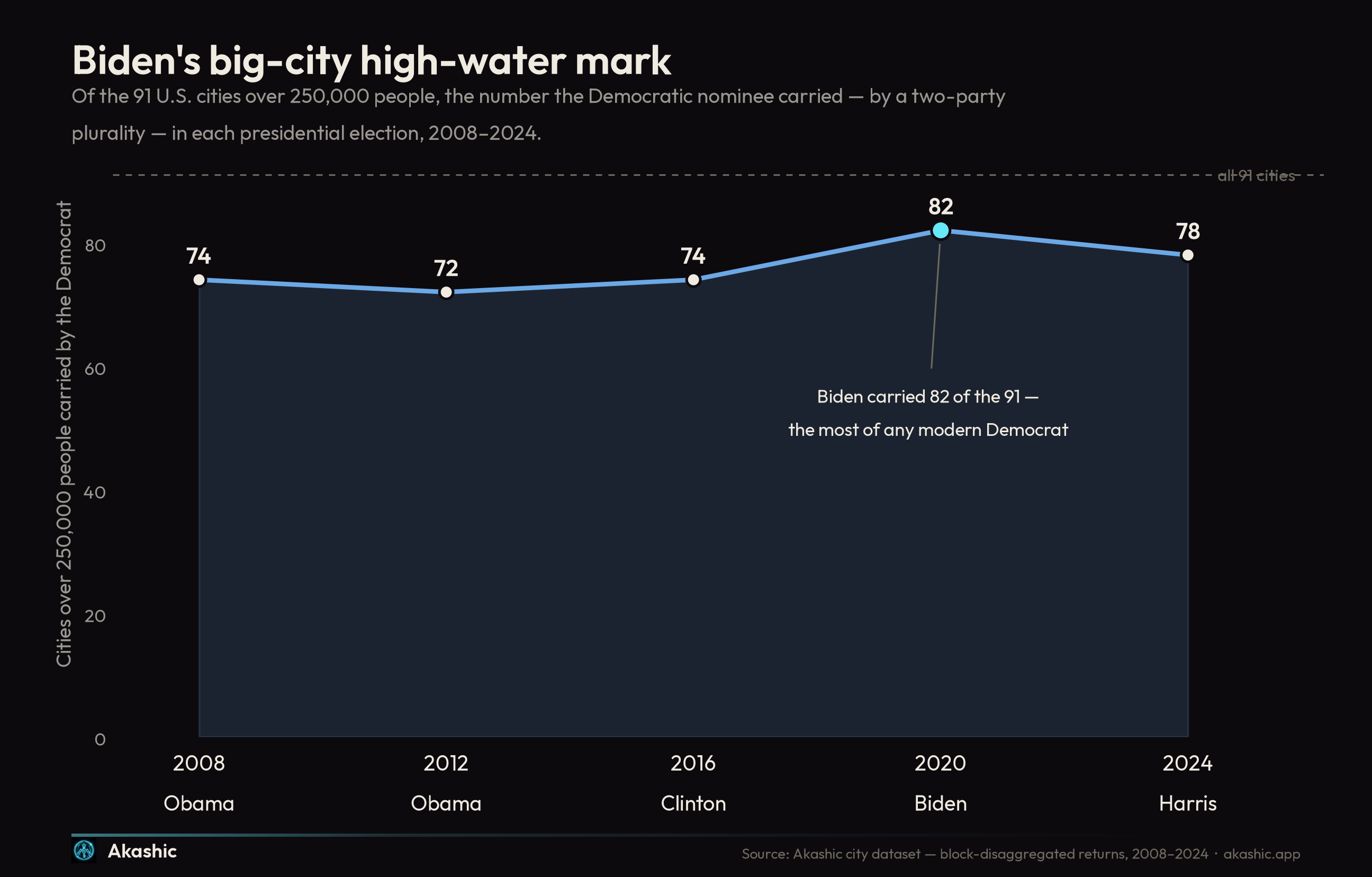
The nine he lost were all Sun Belt and Plains exurbs — Lubbock, the Phoenix suburbs of Gilbert and Mesa, Henderson, Colorado Springs, Bakersfield, Wichita, Corpus Christi, Oklahoma City — not one dense urban core among them. Yet for all that breadth, Biden's deepest margins sit in just 66 counties — the long-blue independent cities of the Chesapeake (Baltimore, Richmond) beside the affluent, educated metros newly arrived to the party (Charlottesville, Marin, Arlington). Wide as an ocean, and in most places a few feet deep.
2024 · Kamala Harris (lost, R+1.5). The retreat to the core and the next frontier at once. Harris's best margins are the deepest college and Pacific-Northwest blue — Portland (Multnomah, D+62), Ithaca, the San Juan Islands — but her vote peaks are the booming New South suburbs: Raleigh (Wake County, 403,000 votes), Atlanta's Fulton and Gwinnett and Cobb, Madison. Even in defeat, the campaign owns the all-time Democratic vote peak across the fastest-growing metros in the country — the territory, perhaps, of whatever comes next.
Broader and shallower
Set the twenty-four campaigns side by side and the modern Democratic coalition reveals its essential shape: broader by votes, narrower by margin. Biden turned out more votes in more places than any Democrat in history and won more large cities than any of them — and still posts his deepest margins in only sixty-six counties. The party that once carried a thousand rural counties by ninety points now carries a hundred cities by twenty and a thousand suburbs by five. By margin, almost the entire country still names Roosevelt or Johnson its best Democrat; the modern campaigns have replaced the all-white Solid South with the Black, Hispanic, Native, and educated-urban coalition — in a few Black Belt counties, the strongholds did not even move on the map, only inverted, the same soil voting the same way for the opposite reason after the Voting Rights Act.
Roosevelt had the depth. Biden had the breadth. Whether the Sun Belt suburbs that gave Harris her 2024 vote peaks become the next FDR-scale territory or stall as Gore's Tennessee and Kerry's Ohio did, the data cannot yet say. What it can say is that no modern Democrat has had depth and breadth at once — and the party has spent ninety years trading one for the other.
A companion piece will map the Republican coalition the same way.